

Essential Skills Required for a Career in Cybersecurity
- Posted by GRMI
- Categories Blog, pgdtrm blog
- Date December 2, 2025
Essential Skills Required for a Career in Cybersecurity
Harshita
A successful career in cybersecurity requires a combination of technical knowledge, governance understanding, and risk-based thinking. This blog explains the key skills needed, including networking fundamentals, IT controls, compliance frameworks like ISO and NIST, and analytical abilities. It also highlights how professionals must connect cybersecurity with business risk, audit, and real-world organisational challenges.
Building a career in cybersecurity requires more than interest or basic IT knowledge. Cyber threats grow more advanced as digital systems support essential organisational tasks.
Firms now seek professionals with strong technical skills, risk awareness, and compliance understanding.
A structured cybersecurity course or a specialised diploma that blends technology, risk, and governance gives a serious advantage.
GRMI has partnered with NU University to offer one such programme, the PGDTRM: Post Graduate Diploma in Technology Risk Management.
This article explains the essential skills for a strong cybersecurity career and how the right programme helps you develop them.
What Makes a Strong Cybersecurity Career: The Skillsets?
Cybersecurity demands technical, analytical, and soft skills. The crucial skill areas appear below.
1. Technical Expertise and Cyber Fundamentals
Network Security and Infrastructure Understanding:
Professionals need a clear grasp of networks, firewalls, data centre controls, and operational controls.
IT General Controls (ITGC) Audit and Compliance Basics:
You must review and test ITGC controls across access and system operations. A good cybersecurity practitioner understands how IT controls relate to audit and compliance frameworks.
Applied Cyber Security and Data Protection:
Practical knowledge in incident response, data loss prevention, digital controls, and privacy protection is essential.
2. Risk Thinking and Governance Perspective
A key difference between cyber technicians and cyber-risk professionals lies in their outlook.
Cyber-risk professionals view cybersecurity as a core business risk.
Risk Assessment and Enterprise Risk Management (ERM):
Organisations need professionals who assess how vulnerabilities may create financial, operational, or reputational risk.
Audit, Compliance, and Regulatory Awareness:
Industries such as banking, healthcare, fintech, and large enterprises expect strong regulatory knowledge.
Linking Cybersecurity to Business Continuity:
Cyber incidents disrupt operations and cause data breaches, losses, and fines. Professionals must think beyond firewalls and understand how security affects business continuity.
3. Flexibility and Lifelong Learning
Cyber threats evolve quickly with new attack methods, regulations, and technologies. Successful cybersecurity careers rely on constant learning and adaptability.
Structured learning programmes help, but self-driven learning remains essential.
Why Does a Structured Programme Count? The Case of PGDTRM
A Short cyber security certification course often cover only basic technical skills. They offer useful foundations but rarely address enterprise risk, governance, audits, and business processes.
This is where the PGDTRM by GRMI-NU delivers distinct value.
Industry-Endorsed Programme and Global Curriculum:
PGDTRM combines cybersecurity, IT governance, risk management, and regulatory compliance. The curriculum covers ITGC, network controls, data controls, audit, and compliance in depth.
Practical Exposure through Paid Internship:
After six months of campus learning, students gain six months of paid internship experience.
Broad Job Role Orientation:
Graduates can work in Technology Risk Management, Data Privacy, Cyber Risk Consulting, Internal Audit, and similar roles.
For those searching cyber security course in Delhi, the GRMI-NU campus may not sit in central Delhi, yet the programme offers broader value than man
Skills You Will Develop in a Programme like PGDTRM
Through PGDTRM, students gain:
- Strong technical knowledge in cybersecurity fundamentals, network security, cloud security, and digital controls.
- Deep understanding of IT governance, standards such as ISO 27001, COBIT, and NIST, and organisational compliance.
- A risk-driven mindset that views vulnerabilities as business risks instead of technical faults.
- Practical exposure through internships, covering cyber risk handling, audits, compliance, and incident response.
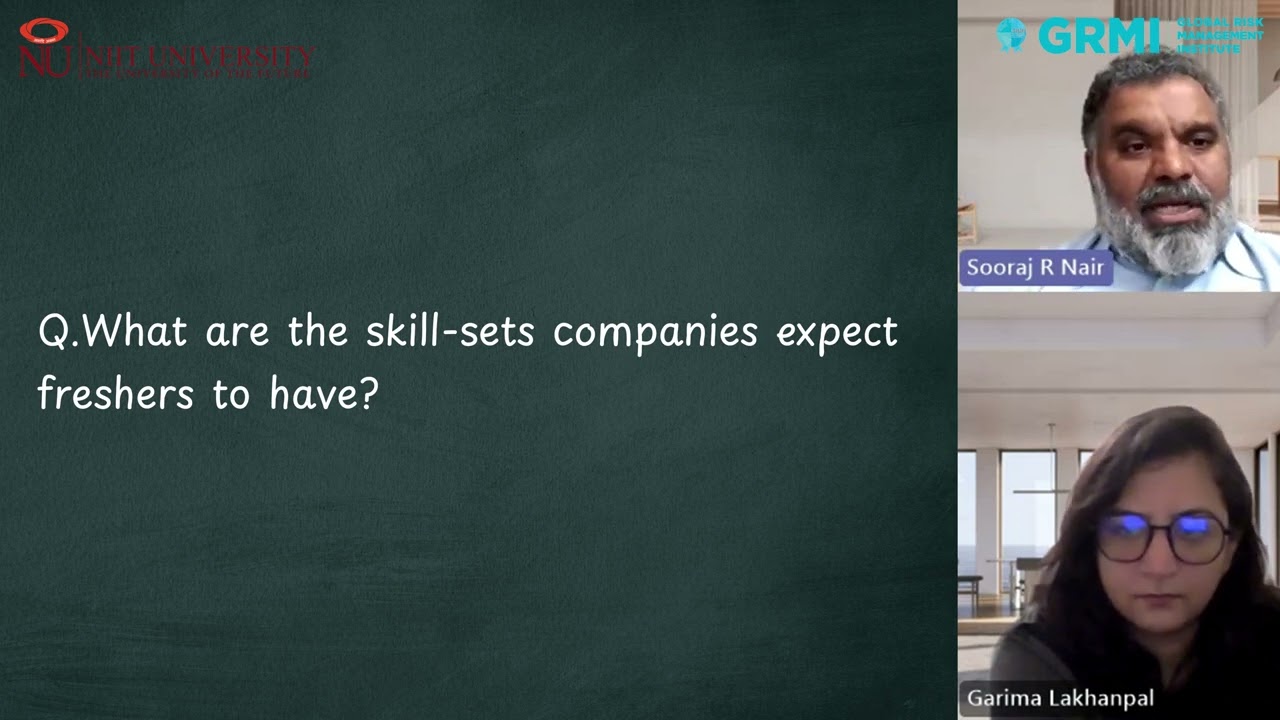
To understand how the PGDTRM programme is structured and delivered, you can watch this short overview video.
Conclusion
A modern cybersecurity career requires more than knowledge of firewalls, malware, or penetration testing. Organisations need professionals who convert cyber threats into enterprise risk insights. They also need experts who understand audit controls, data governance, and business operations.
To build such a career, a balanced programme combining cybersecurity, risk management, governance, and hands-on learning is crucial. One strong example is the GRMI PGDTRM at NU University, which offers a global-standard curriculum, industry-focused training, and a six-month paid internship.
This prepares students for diverse cybersecurity and risk-related careers.
FAQ's
Q1: Who can enrol in PGDTRM?
Graduates from any discipline with up to four years of work experience can enrol.
Even non-technical learners can shift into cybersecurity risk through this programme.
Q2: What job opportunities are available after completing this programme?
Roles include Technology Risk Analyst, Cyber Risk Consultant, SOC Analyst, IT Audit and Controls Manager, Data Privacy Analyst, and Internal Audit Analyst.
Q3: What salary can I expect after completing PGDTRM?
GRMI’s published data indicates initial CTC or internship salaries of about 6–9 LPA for most roles.
For any queries, please fill out the form
You may also like

Risk Appetite vs Risk Tolerance: Guide for 2026

Best 1-Year Courses After Graduation in 2026

