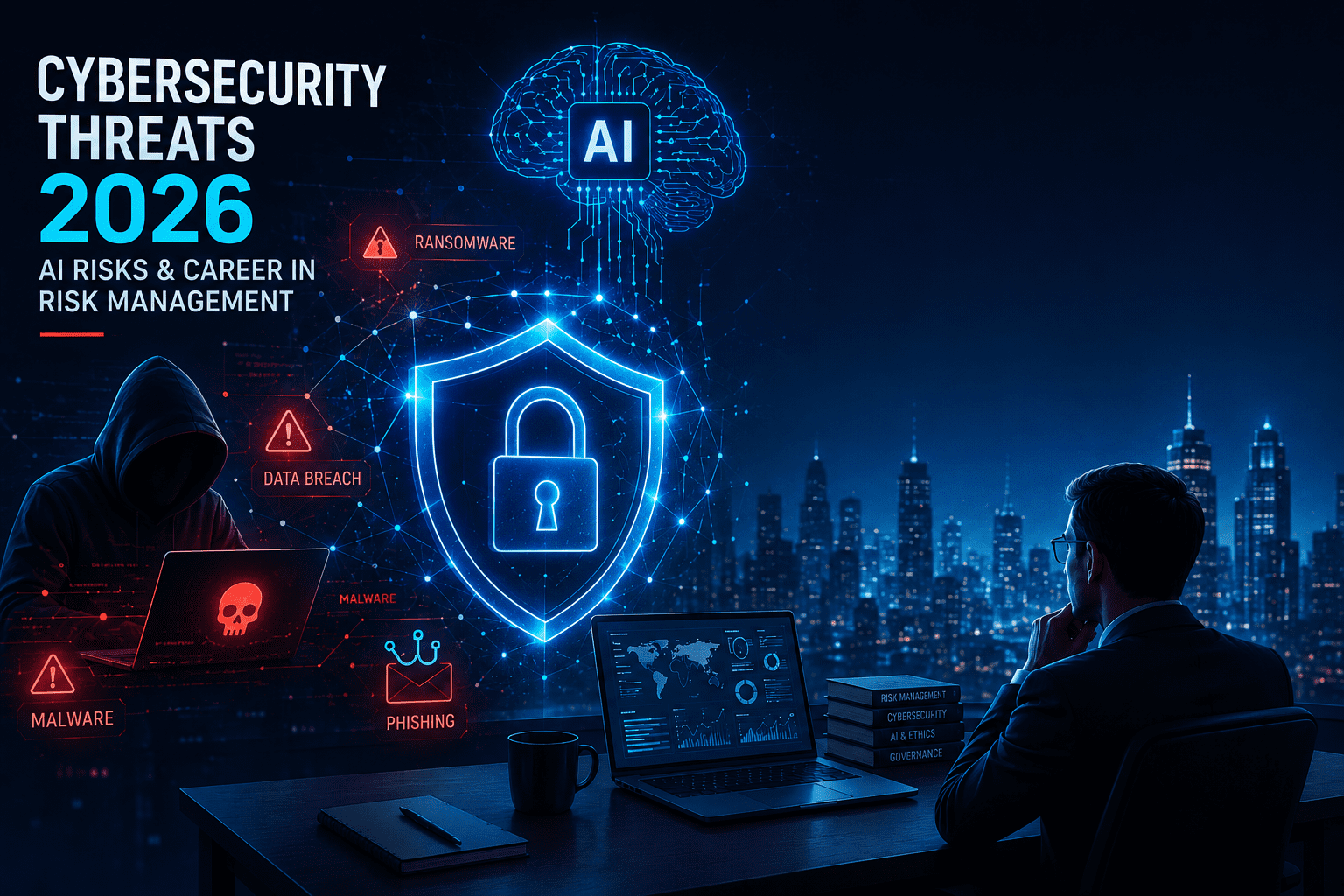
Cybersecurity Threats 2026: AI Risks & Career in Risk Management
Cybersecurity Threats 2026: AI Risks & Career in Risk Management
Overview:
This blog explores the rising cybersecurity threats in 2026, including increasing phishing attacks, AI-driven cyber risks, and evolving digital vulnerabilities across businesses. It highlights how organisations continue to face challenges despite stronger security measures. The article also explains the growing importance of cyber risk management as a core business function and outlines emerging career opportunities in this field.
Cybersecurity Threats in 2026: Rising Breaches, AI Risks, and Career Pathways in Risk Management
Cybersecurity has become a central part of global risk discussions as organisations continue to face increasing digital threats. Recent UK government data for 2025/26 shows that more than 43% of businesses experienced at least one cyber breach or attack in the past year. Around 612,000 businesses reported incidents, reflecting how deeply cyber risks have penetrated modern business environments.
One of the most common attack methods remains phishing.
Phishing refers to fraudulent attempts where attackers trick individuals into revealing sensitive information such as passwords, banking details, or system access through fake emails, messages, or websites.
Nearly 38% of businesses reported phishing-related incidents, showing that human behaviour remains a critical vulnerability in cybersecurity systems. Despite improved awareness and security investments, such attacks continue at scale.
Although the overall percentage has slightly declined compared to 2023/24—when nearly 50% of businesses reported breaches—the risk environment remains structurally high. This indicates that cyber threats are not reducing; they are becoming more advanced and targeted.
AI is Changing the Cyber Threat Landscape
A major shift in cybersecurity today is the use of artificial intelligence by attackers. AI is now used to automate attacks, personalise phishing messages, and generate synthetic media such as deepfakes.
Deepfakes refer to AI-generated audio or video content that can realistically mimic real people, often used to manipulate or deceive targets.
This evolution has significantly increased the complexity of cyber threats. UK cyber security authorities have warned that AI is making cybercrime faster, scalable, and harder to detect. Governments have also issued formal alerts urging organisations to strengthen their cyber defence systems urgently.
In addition, concerns around state-backed cyber activity continue to rise, particularly targeting critical infrastructure, financial systems, and large enterprises. Cybersecurity is therefore no longer just a technical issue—it has become a matter of national and economic security.
From banking and consulting to healthcare and e-commerce, organisations are increasingly relying on Information Technology professionals to manage digital transformation and business operations.
Because of this shift, students are actively exploring technology-focused programmes that provide practical industry exposure and strong career opportunities. One of the most popular options among students is a Diploma of Information Technology.
This programme helps students develop technical skills, industry knowledge, and practical understanding of modern IT systems while opening pathways towards high-growth careers in the technology sector.
Why Businesses Still Struggle with Cybersecurity
Despite access to advanced security tools, organisations continue to experience repeated breaches. The core issue often lies in implementation gaps rather than technology limitations.
Small and mid-sized businesses face challenges such as limited cybersecurity budgets, lack of skilled professionals, and outdated infrastructure. These constraints increase exposure to cyber risks.
Another major factor is human error. Employees often become the weakest link in security systems. Even a single click on a malicious link can compromise entire networks.
At a broader level, rapid digital transformation has expanded risk exposure. Cloud systems, remote working models, and interconnected platforms have increased the number of entry points for attackers.
Cyber Risk Management as a Core Business Function
Cybersecurity is no longer treated as a standalone IT responsibility. It has evolved into a key component of enterprise risk management (ERM).
Enterprise Risk Management refers to a structured approach used by organisations to identify, assess, and manage risks that could impact business performance or continuity.
Within this framework, Governance, Risk and Compliance (GRC) plays a critical role.
GRC refers to the integrated management of governance structures, risk policies, and regulatory compliance requirements within an organisation.
As a result, companies now require professionals who understand both cyber threats and business risk structures. This has increased demand for cyber risk analysts, governance specialists, and compliance professionals across industries such as banking, consulting, IT services, and insurance.
Building Industry-Ready Skills with PGDTRM (GRMI–NIIT Collaboration)
To address this growing demand, structured learning in risk management becomes essential. The Post Graduate Diploma in Technology Risk Management (PGDTRM) under the GRMI–NIIT collaboration is designed to build strong industry-aligned capabilities.
The curriculum follows a progressive learning path that develops both conceptual understanding and practical application.
Key Learning Areas:
- Foundations of Risk Management and Business Risk Concepts
- Information Security and Cyber Risk Fundamentals
- Financial and Operational Risk Understanding
- Governance, Risk and Compliance (GRC) frameworks
- Regulatory and Industry Risk Standards
- Data Analytics for Risk Assessment
- Emerging Technologies (AI, Cloud, Digital Risk)
- Risk Modelling and Control Frameworks
- Real-world Case Studies
- Capstone Industry Project
Real-World Learning Clarity in the First 6 Months
Within the first six months of the programme, learners build strong conceptual foundations while also engaging with structured case studies and applied risk scenarios.
This phase is designed to provide real-world clarity, helping learners understand how organisations identify, assess, and manage risks in practical environments. Instead of isolated theory, learners experience how risk functions operate within real business systems.
This early exposure bridges the gap between academic learning and industry expectations, preparing learners for advanced application-based modules in later stages.
Why This Curriculum Matters
Modern risk roles require more than theoretical knowledge. Professionals must analyse real-time risks, respond to cyber incidents, and support decision-making through structured risk frameworks.
The PGDTRM curriculum ensures learners develop these capabilities through a combination of technical knowledge, governance understanding, and applied learning. This makes graduates industry-ready for dynamic roles where risk management directly impacts business continuity.
Conclusion
Cybersecurity threats continue to rise globally, driven by AI-powered attacks, human vulnerabilities, and expanding digital ecosystems. The UK data clearly reflects the scale and persistence of these risks.
At the same time, this evolving threat landscape has created strong career opportunities in cyber risk and enterprise risk management. Professionals who understand both business and technology risks are increasingly valued across industries.
Structured programmes like the GRMI–NIIT PGDTRM help bridge this gap through applied learning, early real-world exposure, and industry-aligned curriculum design. In a rapidly evolving digital world, such programmes play a crucial role in shaping future-ready risk professionals.
FAQ's
Cyber attacks are rising due to AI-driven tools, human errors, and increasing digital dependence.
Phishing is a fraudulent technique used to trick individuals into revealing sensitive information through fake communication channels.
AI enables attackers to automate scams, personalise attacks, and create realistic deepfake content.
GRC stands for Governance, Risk and Compliance, a framework used to manage organisational risks and regulatory obligations.
PGDTRM provides structured learning, case studies, and early real-world exposure to build practical risk management skills.
You may also like

Best Post Diploma Courses in India for 2026

Best IT Diploma Courses with Highest Job Demand in 2026