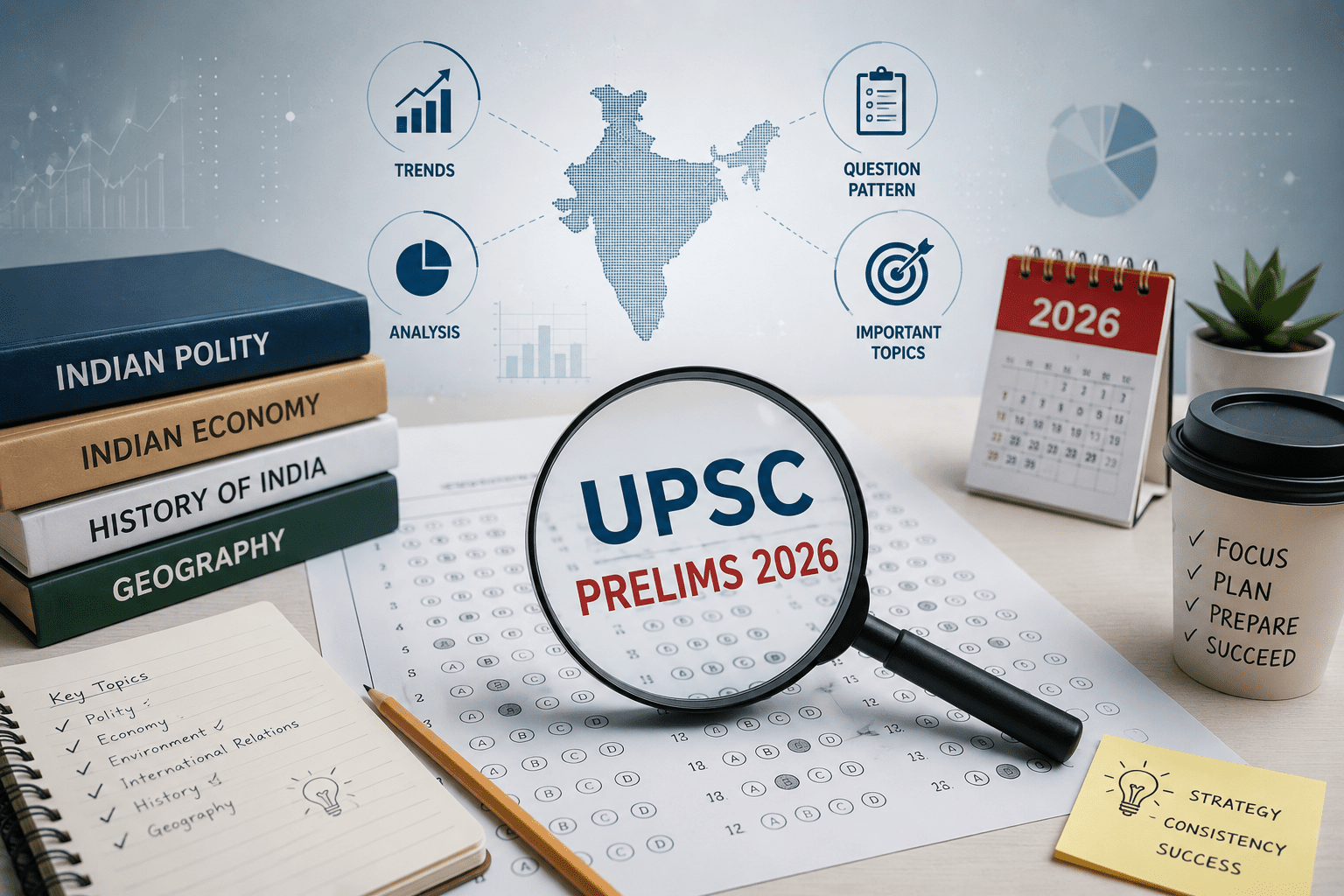
UPSC Prelims 2026 Analysis: Exam Trends & Question Pattern
UPSC Prelims 2026 Analysis: Exam Trends & Question Pattern
Overview
This blog analyses UPSC Prelims 2026, focusing on changing exam patterns, increased difficulty, and the shift from rote learning to conceptual and analytical questions. It covers subject-wise trends in Polity, History, Economy, Environment, and CSAT, highlighting how UPSC is testing application-based understanding. The article also discusses rising competition and why aspirants should explore emerging career options like Risk Management alongside traditional preparation paths.
UPSC Prelims 2026: A Wake-Up Call for Aspirants in an Era of Unpredictable Competition
The UPSC Civil Services Preliminary Examination 2026 once again proved why it is often called one of the most unpredictable competitive examinations in India. This year’s paper moved far beyond conventional preparation patterns and tested not only knowledge, but also adaptability, analytical thinking, decision-making, and emotional composure under pressure.
For lakhs of aspirants across the country, the examination served as a reminder that the nature of competitive exams in India is rapidly evolving. Rote learning and repetitive revision alone are no longer sufficient. UPSC now expects candidates to think critically, connect concepts across subjects, and apply logic in unfamiliar situations.
While there were certainly manageable questions in both General Studies and CSAT, what stood out most was the unconventional framing of questions. Many aspirants reported that even familiar topics appeared in completely unexpected formats. The examination consistently pushed candidates outside their comfort zones.
For years, subjects like Polity were considered relatively stable and predictable. Aspirants often relied heavily on a limited set of standard books, memorising Constitutional Articles and repeatedly revising familiar concepts. However, UPSC Prelims 2026 disrupted this pattern significantly.
This year, the examination moved beyond direct factual recall and demanded legal precision, conceptual clarity, and deeper constitutional understanding.
Simply remembering Articles was no longer enough. Candidates were expected to understand the practical interpretation of constitutional provisions, governance structures, and administrative reasoning.
Similarly, History moved beyond predictable Modern India questions and placed stronger emphasis on Ancient India, Art & Culture, Buddhism, Jainism, temple architecture, and archaeological themes. Some questions were framed in such an unconventional and closely layered manner that even highly prepared aspirants found themselves confused between options.
In several cases, simply collecting more information or memorising additional facts was not enough. UPSC appeared to test interpretation, conceptual clarity, attention to detail, and the ability to remain calm while handling uncertainty.
The message from UPSC was clear: traditional rote-learning approaches alone are no longer enough in an increasingly unpredictable examination environment. Aspirants now need analytical thinking, interdisciplinary understanding, and the ability to apply concepts in unfamiliar situations.
Interestingly, these are the same abilities that industries today increasingly value across domains such as Governance, Risk, Compliance, Consulting, and Strategic Decision-Making.
Analytical Thinking Became the Core Skill
One of the most interesting developments this year was the integration of analytical and ethics-oriented thinking into objective questions. Candidates were expected not only to recall facts but also to interpret administrative situations, understand governance implications, and make logical judgments.
Economy questions reflected the changing realities of India’s digital financial ecosystem. Topics such as ONDC, tokenisation, sustainability bonds, Digital Rupee, financial inclusion, and fintech systems appeared prominently.
Likewise, Science & Technology questions focused heavily on contemporary developments such as blockchain, green hydrogen, drone swarms, quantum missions, and large language models (LLMs).
Current affairs were no longer treated as a separate section. Instead, they were deeply integrated with static subjects such as Geography, Environment, Economy, Polity, and History.
This transformation reflects a larger shift in India’s competitive examination ecosystem — one where interdisciplinary understanding and practical awareness matter more than memorisation alone.
Competition Is Increasing Every Year
Another reality that aspirants cannot ignore is the sheer scale of competition associated with UPSC. Every year, lakhs of candidates compete for a very limited number of positions. Even highly capable and hardworking aspirants often spend multiple years preparing without certainty of selection.
This does not reduce the prestige of the Civil Services. In fact, it highlights the immense difficulty and unpredictability associated with the examination.
However, in today’s rapidly changing professional landscape, students and graduates must also think practically about career planning.
Preparing for UPSC can certainly build discipline, awareness, and analytical ability, but depending entirely on one examination for career success may not always be the smartest long-term strategy.
Why Students Should Explore Emerging Career Domains
The modern corporate world is creating strong demand for professionals who can handle uncertainty, compliance, governance, financial risks, cybersecurity risks, operational challenges, and strategic decision-making.
This is exactly why domains such as Risk Management, Risk Consulting, Governance, Compliance, and Financial Risk are emerging as high-growth career opportunities.
Many students are still unaware that alongside these, there are several other professional domains which offer even stronger conceptual clarity, structured learning, and wider exposure across both government-linked ecosystems and private industry.
These careers also open doors in top MNCs, consulting firms, and Big 4 organisations, where analytical thinking and decision-making are highly valued.
Unlike highly unpredictable examination systems, these industries focus strongly on practical skills, industry readiness, and professional competence.
As organisations become more regulated and technology-driven, they increasingly require professionals who can identify, assess, and manage risks effectively.
A Smart Alternative: Post Graduate Diploma in Risk Management
For students looking to build future-ready careers with strong industry relevance, specialised programmes like the Post Graduate Diploma in Risk Management offered by Global Risk Management Institute (GRMI) can be a strong alternative worth considering.
The programme is designed to move beyond theoretical learning and focus on real-world business exposure, helping students understand how organisations deal with uncertainty, risk, and decision-making in complex environments.
It covers key areas such as:
Enterprise Risk Management (ERM) applied to real business situations
Financial, market, and credit risk frameworks used in global organisations
Governance, Risk, and Compliance (GRC) structures followed in corporates
Regulatory systems and policy-driven decision-making
Analytical and problem-solving tools used in consulting and advisory roles
Industry-based case studies and practical learning modules
What makes GRMI’s programme particularly relevant today is the kind of career outcomes it enables. As per programme outcomes, over 85% of alumni are placed in top consulting firms and Big 4 organisations, reflecting strong industry acceptance of the skill set developed through the course.
In addition, more than 325 alumni have already trusted and completed the programme, building careers across consulting, risk advisory, banking, fintech, and corporate governance roles.
Interestingly, a growing number of students from competitive exam backgrounds, including UPSC aspirants, are also exploring this pathway as an alternative career direction. The reason is simple — it offers structured learning, strong analytical training, and direct exposure to industry environments where decision-making and critical thinking are essential.
Graduates from GRMI are now working across both private sector organisations and government-linked projects, especially in areas involving governance, compliance, and risk-based advisory work.
Overall, Risk Management is emerging as a field where analytical thinking is not just theoretical but applied in real business environments — making it a practical and future-oriented career option for today’s graduates.
Final Thoughts
UPSC Prelims 2026 demonstrated one important reality very clearly: success today depends not only on hard work, but also on adaptability, awareness, and strategic career thinking.
For some students, Civil Services will continue to remain the dream destination — and rightly so. However, it is equally important for aspirants to stay aware of emerging industries and alternative professional opportunities that offer strong growth, corporate exposure, and long-term career stability.
The future belongs to individuals who combine ambition with smart decision-making.
You may also like

Best 1-Year Courses After Graduation in 2026

Enterprise Risk Management Framework: Guide for 2026