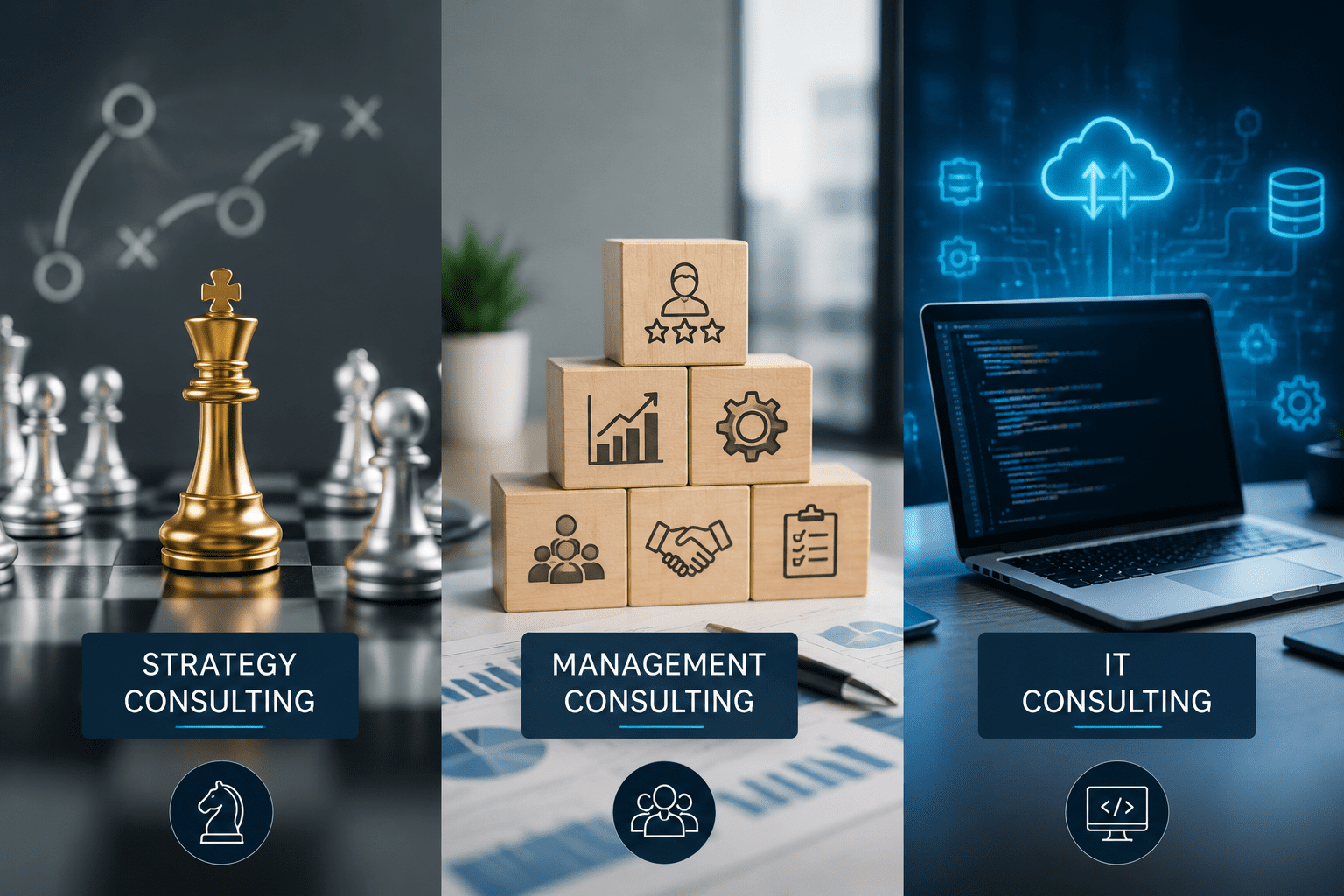
Types of Consulting in India: Strategy vs Management vs IT
- Posted by GRMI
- Categories Blog, pgdrm blog
- Date July 8, 2026
Types of Consulting in India: Strategy vs Management vs IT
Jump to ↓
Author: Anjori
This blog explains the three major types of consulting careers in India—strategy consulting, management consulting, and IT consulting—and compares them in terms of work nature, salaries, entry requirements, and career growth. It helps graduates understand how firms like McKinsey, Deloitte, and Accenture differ and guides them in choosing the right consulting career path based on skills, interests, and long-term goals.
Strategy vs Management vs IT Consulting: Which is Best?
Consulting in India is not a single career; rather, it is three distinct ones. Strategy consulting, management consulting and IT consulting each involve different types of work, attract different firm types, reward different skill sets, and open different doors after two to three years.
For a fresh graduate in India choosing between offers at McKinsey, Deloitte, and Accenture, it is important to understand the difference in daily work, career trajectories, and long-term earning opportunities each firm offers. This blog breaks down all three tracks and helps Indian graduates decide what is best career option after graduation and which path is the best fit for them
Why This Comparison is So Important
India’s consulting market is expanding across all three domains simultaneously. IT consulting is growing due to digital transformation, management consulting is expanding as businesses become more complex, and strategy consulting is benefiting from India’s growing start-up and private equity ecosystem.
According to the Aon Annual Salary Increase and Turnover Survey 2025–26, Indian salaries are projected to grow by 9% in 2026 overall. However, within consulting, strategy roles typically command higher compensation than generalist or IT service positions.
For graduates deciding their path, understanding these differences is essential.
What are the Three Types of Consulting?
1. Strategy Consulting
Strategy consulting advises senior leadership (CEO and board-level executives) on high-stakes decisions such as market entry, competitive strategy, restructuring, and transformation.
In India, firms like McKinsey, BCG, Bain, and Tier-2 firms such as Kearney and EY-Parthenon dominate this space. Work is hypothesis-driven, research-heavy, and presentation-oriented.
- Entry-level salary: ₹15–20 LPA (undergraduate), ₹30–40 LPA (post-MBA)
- Hiring: Highly selective (top IIMs, IITs, ISB)
- Nature of work: High ambiguity, structured problem-solving, PowerPoint-heavy analysis
2. Management Consulting
Management consulting focuses on improving business operations, reducing costs, restructuring organisations, and supporting transformation initiatives.
The Big 4 firms (Deloitte, PwC, EY, KPMG) are major employers in India.
- Average salary: ~₹20.4 LPA (varies by experience)
- Entry-level range: ₹10–16 LPA
- Nature of work: Functional consulting, implementation-focused, longer client engagements
This track is more accessible and offers exposure to diverse industries and functions such as finance, operations, risk, and supply chain.
3. IT Consulting
IT consulting helps organisations adopt and optimise technology solutions such as cloud systems, AI integration, cybersecurity, and digital transformation.
Major employers include Accenture, TCS, Infosys, IBM Consulting, and Deloitte Digital.
- Entry-level salary: ₹3.3–6.5 LPA (service firms)
- Consulting track roles: ₹12–24 LPA (Accenture Strategy, Deloitte Digital, etc.)
- Growth rate: >15% annually in India
This is the largest and fastest-growing consulting segment in India, driven by digital transformation and AI adoption.
Key Differences: A Direct Comparison
Work Nature
- Strategy: High-level problem solving for CEOs
- Management: Functional execution and business improvement
- IT: Technology implementation and digital transformation
Entry-Level Salary (India)
- Strategy (MBB): ₹15–20 LPA; post-MBA ₹30–40 LPA
- Management (Big 4): ₹10–16 LPA
- IT Consulting: ₹3.3–6.5 LPA (service firms), up to ₹24 LPA (strategy IT roles)
Access & Competition
- Strategy: Extremely competitive (<1% acceptance at MBB)
- Management: Wider campus recruitment base
- IT: Highest volume of hiring (e.g., TCS ~42,000 hires annually)
Exit Opportunities
- Strategy: PE, VC, corporate strategy, top MBA programmes
- Management: Operations, finance, advisory roles
- IT: Product management, GCCs, AI/data science roles
Which Consulting Path is Best?
There is no single “best” consulting track. The right choice depends on your strengths and goals:
Choose Strategy Consulting if:
You enjoy complex problem-solving, high-pressure environments, and aim for top-tier global roles or MBA pathways.
Choose Management Consulting if:
You want balanced exposure to strategy and execution with broader entry opportunities and strong corporate learning structures.
Choose IT Consulting if:
You have a technology interest and want high-volume opportunities in India’s fastest-growing consulting segment.
How GRMI Prepares You for All Three Tracks
Whether you aim for strategy consulting at McKinsey, management consulting at Deloitte, or IT consulting at Accenture, strong analytical and risk-based thinking is essential.
GRMI builds capabilities in enterprise risk, financial frameworks, governance, and structured decision-making. These skills are directly relevant across all consulting tracks:
- Strategy consulting: Structured analytical thinking
- Management consulting: Functional and operational depth
- IT consulting: Governance and risk understanding in digital transformation
Conclusion
Strategy, management, and IT consulting represent three distinct but equally powerful career paths in India. Each offers unique opportunities, challenges, and growth trajectories.
For Indian graduates, success depends not on prestige alone but on aligning career choice with skills, interests, and long-term goals. With India’s consulting market expanding rapidly, all three paths offer strong future potential.
FAQ's
Yes, mainly. MBB firms focus on top-tier institutes, although Tier-2 firms also recruit from a broader pool.
Strategy consulting offers the highest salaries, followed by management consulting and IT consulting.
Analytical thinking, problem-solving, communication, business acumen, project management, and stakeholder management are among the most important skills.
Yes, usually through a top MBA or by moving into advisory-focused roles before transitioning.
Strategy consulting offers the fastest high-level exits, while IT consulting offers the widest volume of opportunities.
Yes. Consulting is growing rapidly due to digital transformation, AI adoption, and business complexity.
You may also like

Best IT Diploma Courses with Highest Job Demand in 2026

Enterprise Risk Management Certification: Guide 2026