FRM Course Duration Explained for New Learners
- Posted by GRMI
- Categories Blog, pgdrm blog
- Date December 23, 2025
FRM Course Duration Explained for New Learners
When considering a career in risk management, the first questions that come to our minds are: What is the FRM course duration? and what are the key FRM course details? This article explains the timeline, syllabus, and career relevance. It also compares the FRM with the GRMI PGDRM programme so you can decide whether to pursue FRM alone or a broader risk-management qualification.
What is FRM and Why is it Popular?
FRM (Financial Risk Manager) certification focuses on financial risk. It covers market risk, credit risk, operational risk, liquidity and treasury risk, financial markets, valuation, risk models, and quantitative risk analysis.
FRM is popular among aspirants seeking roles such as Risk Analyst, Market Risk Manager, Credit Risk Officer, or other finance and risk positions in banks, asset management firms, consultancies, or financial institutions. Its global recognition and design by industry professionals make it highly sought after.
FRM Course Duration
FRM is an exam-based qualification rather than a traditional degree. Duration depends on your background, pace, and exam schedule.
- Average length: 1–2 years, depending on how quickly you attempt both parts.
- Study hours: Part I requires around 150–200 hours (approximately 3–6 months). Part II may need 200–250 hours over several months.
- Flexible schedule: FRM allows self-directed learning. Working professionals or students may take 12–24 months to complete it.
Typically, committed candidates finish FRM in one year, while those balancing work or study may take up to two years.
Key Facts About FRM
- No strict academic requirements: FRM does not require a specific degree, though backgrounds in finance, economics, statistics, or quantitative fields help.
- Broad syllabus: Topics include financial markets, valuation, risk modelling, market and credit risk, operational risk, liquidity, treasury risk, and advanced quantitative risk methods.
- Learning route: Candidates can pursue self-study or coaching. Online study and practice materials supplement preparation.
- Career relevance: FRM roles are mostly in banking, fintech, consultancy, and asset management
Comparing FRM Course Details with GRMI’s PGDRM
GRMI’s PGDRM programme offers a broader risk-management curriculum than FRM:
- Course length: PGDRM is a one-year full-time, on-campus programme.
- Scope of risks: FRM focuses on financial risk. PGDRM covers financial risk plus operational, cyber/IT, ESG, compliance, and enterprise-wide risks.
- Learning model: PGDRM uses classroom sessions, industry-led curriculum, hands-on projects, internships, and placement support. FRM relies on self-study.
- Career flexibility: PGDRM graduates gain risk-management skills applicable across industries, not only in finance.
Candidates interested in financial markets and risk analytics can benefit from FRM. Those seeking a more diversified career in risk management may prefer PGDRM at GRMI.
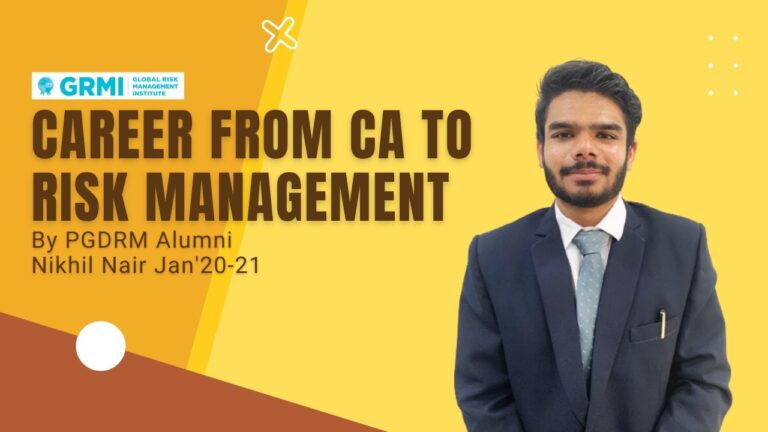
Watch this video where a CA shares their journey after switching to PGDRM
Career Paths and Salary Prospects in Risk Management
Freshers completing GRMI’s PGDRM programme can expect starting salaries in the range of ₹5–8 LPA. Mid-level professionals, with 3–5 years’ experience in risk management, cybersecurity governance, or compliance roles, can earn ₹12–20 LPA or more, depending on the organisation and responsibilities.
- Junior Risk Analyst / Credit Risk Analyst – Assess credit risk, analyse borrower data, and support lending decisions.
- Market Risk Analyst / Treasury-Risk Analyst – Monitor market risk, manage liquidity or treasury exposure, and evaluate interest-rate or FX risks.
- Operational Risk / IT-Risk Associate – Manage internal controls, compliance, cybersecurity governance, and audit IT or operational processes.
- Risk & Compliance Officer / Risk Control Specialist – Design and implement risk-management frameworks, ensure regulatory compliance, and conduct internal audits.
- Risk Consultant / Advisory Analyst – Support corporate clients or consulting firms with risk assessments, compliance, and enterprise risk strategies
Final Thoughts
In summary, while FRM focuses on financial risk with flexible self-study over 1–2 years, GRMI’s PGDRM delivers a comprehensive, industry-oriented risk management education. Its one-year programme combines classroom learning, hands-on projects, internships, and placement support, equipping students with the skills and connections to launch a successful career across diverse risk domains.
FAQ's
Q1: How long does FRM really take?
Ans: 12–24 months, depending on how quickly you pass both parts. Some committed candidates complete it in one year.
Q2: Do I need a specific background to start FRM?
Ans: No, but finance, economics, statistics, or quantitative experience can help.
Q3: Can I study FRM while working or studying?
Ans: Yes. FRM is self-paced and designed for working professionals, though this may extend the completion time.
Q4: What makes GRMI’s PGDRM different from other risk management programmes?
Ans: A: GRMI’s PGDRM combines classroom learning, industry-led curriculum, hands-on projects, and a six-month paid internship. It covers financial, operational, IT/cyber, and compliance risk, providing a broader skillset than typical finance-only certifications.
For any queries, please fill out the form
Tag:FRM Course
You may also like

Start Finance Career After Graduation Without MBA