
How to Become a Management Consultant in India | Salary
- Posted by GRMI
- Categories Blog, pgdrm blog
- Date March 27, 2026
How to Become a Management Consultant: Salary, Skills, Qualifications and Career Path
You might have heard someone say, “I want to go into consulting,” without fully understanding what that actually means in practice. This confusion is common because consulting is not a single role but a career path that involves solving real business problems.
Imagine being asked why a company’s profits are falling or how a brand can expand into a new market successfully. A management consultant is the person expected to break down that problem, analyse data, and recommend a clear solution.
For students and aspirants, this makes consulting exciting, as every project feels different and offers exposure to real-world challenges.
What Does a Management Consultant Actually Do
A Day in the Life of a Consultant
Consider a situation where a retail company is facing declining sales despite increasing customer footfall across multiple store locations. A consultant studies customer behaviour, pricing strategies, and operational inefficiencies to identify what is not working effectively.
The solution might involve redesigning store layouts, improving product placement, or adjusting pricing based on consumer demand patterns. This process shows how consultants move from problem identification to structured solutions that create measurable business impact.
Roles and Responsibilities Made Simple
Instead of complex definitions, it helps to understand consulting responsibilities through how work actually happens in real business situations.
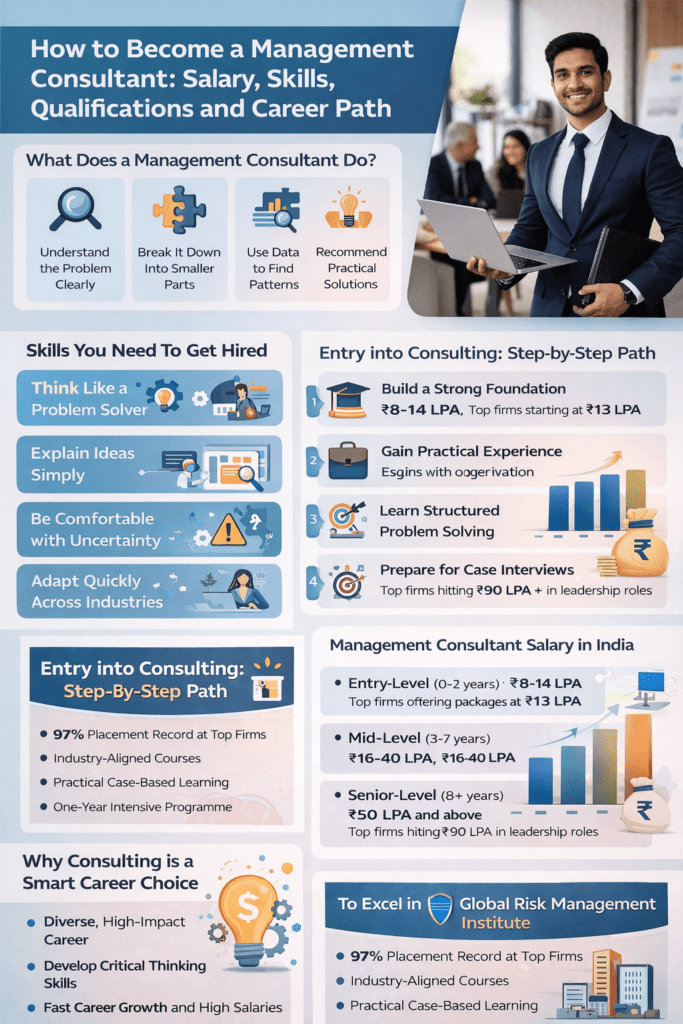
1. Understanding the Problem Clearly: A company may feel something is wrong, but the exact issue often remains unclear without structured analysis and proper data evaluation.
2. Breaking It Down into Smaller Parts: For example, declining revenue can be linked to pricing, customer experience, marketing, or operational inefficiencies within the organisation.
3. Using Data to Find Patterns: Consultants rely on numbers, reports, and market insights instead of assumptions to identify trends and support their recommendations effectively.
4. Recommending Practical Solutions: The focus remains on realistic strategies that companies can implement rather than theoretical ideas that lack real-world feasibility.
5. Supporting Implementation: Consultants often work alongside teams to ensure strategies are executed properly and deliver expected outcomes over a defined timeline.
Skills You Actually Need (Not Just What Everyone Says)
Many students believe consulting only requires strong academics, but the role demands a combination of thinking ability and communication skills.
Think Like a Problem Solver
Imagine being given a messy situation with no clear answer, where you need to create structure and identify logical next steps.
Explain Ideas Simply
Even the best solution fails if it cannot be explained clearly to a client who expects clarity, confidence, and practical direction.
Be Comfortable with Uncertainty
Consulting rarely offers perfect information, which means decisions are often made with incomplete data and evolving situations.
Adapt Quickly Across Industries
One project could involve banking, while the next might focus on healthcare or technology, requiring fast learning and flexibility.
What Should You Study to Enter Consulting
There is no single fixed path, but certain educational choices can make the journey smoother and more structured.
Most candidates start with degrees in business, economics, or finance, which provide a foundation for understanding how organisations operate.
However, what truly differentiates candidates is their ability to apply knowledge through case studies, internships, and real-world problem-solving exposure.
Many students later choose specialised postgraduate programmes to bridge the gap between academic knowledge and industry expectations.
Step-by-Step Path to Become a Consultant
Step 1: Build a Strong Foundation: Start by understanding basic business concepts, including finance, operations, and market behaviour across industries.
Step 2: Gain Real Exposure: Internships, live projects, and case competitions help in developing practical thinking beyond theoretical classroom learning.
Step 3: Learn Structured Problem Solving: Consulting firms expect candidates to approach problems logically, often using frameworks to break down complex situations effectively.
Step 4: Prepare for Case Interviews: These interviews simulate real consulting scenarios where candidates must analyse problems and present solutions under time constraints.
Step 5: Enter the Industry: Opportunities exist in consulting firms, Big Four companies, and corporate strategy roles across different sectors.
Management Consultant Salary in India
Management consulting remains one of the highest-paying career paths in India, with salaries increasing significantly based on skills, experience, and firm reputation.
According to recent industry data, the average salary of a management consultant in India is around ₹20 LPA, although this varies widely.
Salary Breakdown by Experience
-
Entry-level (0–2 years): ₹8–14 LPA, with top firms offering packages starting around ₹13 LPA.
-
Mid-level (3–7 years): ₹16–40 LPA depending on role, performance, and company tier.
-
Senior-level (8+ years): ₹50 LPA and above, with top consulting firms crossing ₹90 LPA in leadership roles.
In top-tier firms such as strategy consulting companies, compensation also includes bonuses, performance incentives, and global project exposure
Why Consulting is Becoming a Smart Career Choice
The modern business environment is becoming more complex, which increases the demand for professionals who can solve problems strategically.
Companies no longer look only for technical skills but also for individuals who can think critically and make informed decisions under pressure.
This shift makes consulting a valuable career path for those who want to build versatile skills and long-term professional growth.
Where Do You Actually Learn These Skills
At this stage, many students understand the role but still struggle with one key question, which is where these skills are actually built.
This gap often exists because traditional education focuses more on theory, while consulting roles demand structured thinking and real-world problem solving.
This is where the Global Risk Management Institute bridges the gap through its Post Graduate Programme in Risk Management.
Why GRMI Stands Out
-
97% placement record across consulting, risk, and advisory roles
-
Placements in Big 4 and top consulting firms including EY, KPMG, PwC, and Deloitte
-
One-year intensive programme designed for fast-track career growth
-
Industry-aligned curriculum focused on real-world business challenges
-
Exposure to consulting, risk, and strategy career pathways
What You Actually Gain
The programme focuses on practical exposure, helping learners build structured thinking, understand business risks, and apply consulting frameworks in real scenarios.
This approach ensures that learners are not just job-ready, but prepared to perform in roles that demand analytical thinking and decision-making from day one.
Conclusion
Management consulting is not just a career option but a way of thinking that focuses on solving problems and creating meaningful impact. With the right skills, exposure, and learning approach, it offers strong growth, high earning potential, and diverse opportunities across industries.
FAQ's
They solve business problems and help organisations improve performance.
It helps, but skills and practical exposure matter equally.
Yes, it offers strong learning and fast career growth.
It varies but is generally higher than many entry-level roles.
Focus on problem-solving, case practice, and real-world exposure.
You may also like


How to Land a Consulting Job in 2026 Without an MBA