Risk Management: what it is, its benefits, and types of risks
- Posted by GRMI
- Categories Blog, pgdrm blog
- Date June 10, 2026
Risk Management: Benefits, Types of Risks & Process Guide
Jump to ↓
Author: Jayant palan
This blog explains what risk management is, why it is important for businesses, the different types of risks organisations face, and the key stages of a modern risk management process. It also explores the benefits of proactive risk management and how GRMI helps organisations strengthen risk capabilities.
Introduction
Every business faces uncertainty. Economic shifts, technological disruptions, regulatory changes, cyber threats, operational failures, and competitive pressures can all impact organisational performance. While uncertainty cannot be eliminated, it can be managed.
This is where risk management becomes essential.
Effective risk management helps organisations identify potential threats, assess their impact, and implement strategies to reduce disruptions before they affect business objectives. Rather than simply reacting to problems, modern organisations use risk management as a strategic tool to support growth, resilience, and informed decision-making.
What Is Risk Management in a Business Context?
Risk management is the systematic process of identifying, assessing, prioritising, and addressing risks that could affect an organisation’s operations, finances, reputation, or strategic objectives.
In a business environment, risk management is not about avoiding risk altogether. Every organisation must take calculated risks to innovate, expand, and remain competitive. Instead, risk management focuses on understanding potential threats and ensuring that decisions are made with a clear awareness of their possible consequences.
Modern risk management supports:
- Better strategic planning
- Stronger governance
- Improved operational resilience
- Regulatory compliance
- Sustainable business growth
When integrated effectively, risk management becomes an important part of organisational decision-making rather than a standalone compliance activity.
What Are the Main Types of Risks?
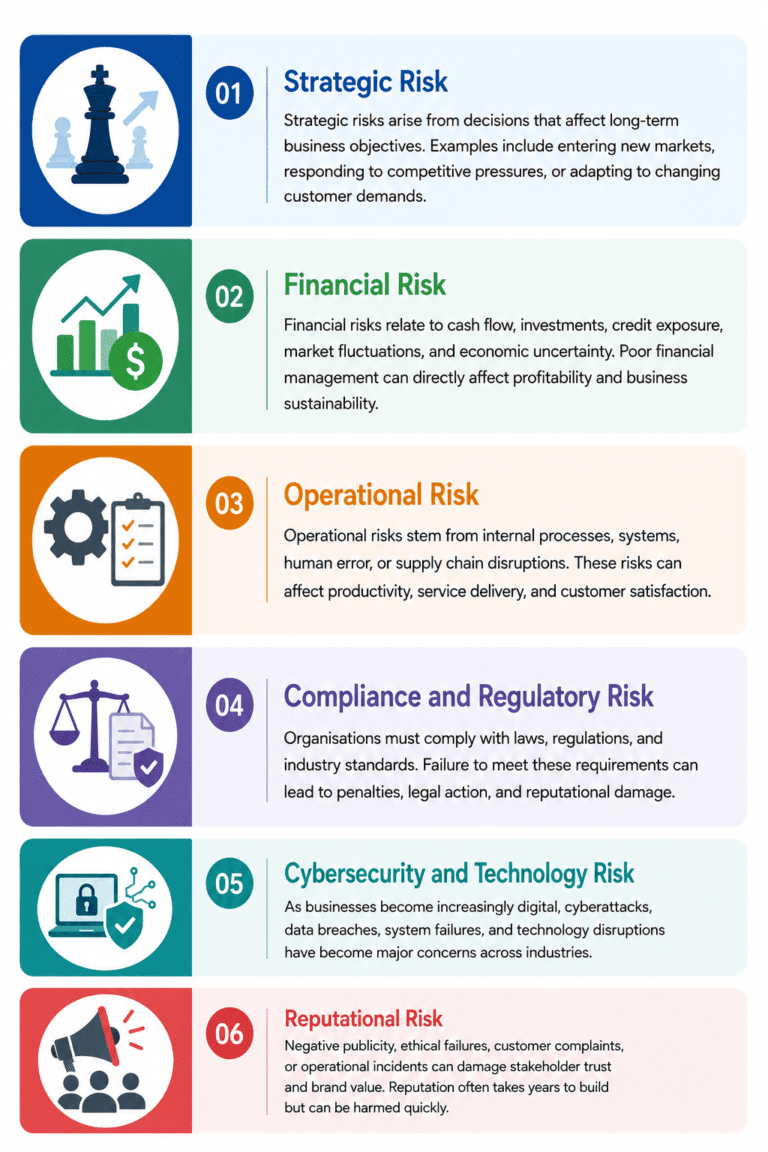
Businesses encounter various forms of risk depending on their industry, size, and operating environment.
Strategic Risk
Strategic risks arise from decisions that affect long-term business objectives. Examples include entering new markets, responding to competitive pressures, or adapting to changing customer demands.
Financial Risk
Financial risks relate to cash flow, investments, credit exposure, market fluctuations, and economic uncertainty. Poor financial management can directly affect profitability and business sustainability.
Operational Risk
Operational risks stem from internal processes, systems, human error, or supply chain disruptions. These risks can affect productivity, service delivery, and customer satisfaction.
Compliance and Regulatory Risk
Organisations must comply with laws, regulations, and industry standards. Failure to meet these requirements can lead to penalties, legal action, and reputational damage.
Cybersecurity and Technology Risk
As businesses become increasingly digital, cyberattacks, data breaches, system failures, and technology disruptions have become major concerns across industries.
Reputational Risk
Negative publicity, ethical failures, customer complaints, or operational incidents can damage stakeholder trust and brand value. Reputation often takes years to build but can be harmed quickly.
What Does a Modern Risk Management Process Look Like?
Risk management is not a one-time exercise. It is a continuous process that evolves as business conditions change.
Risk Identification
The first step involves identifying potential events or situations that could affect organisational objectives.
This may include:
- Internal process failures
- Market changes
- Regulatory developments
- Technology disruptions
- Emerging industry trends
Organisations use workshops, audits, risk registers, and stakeholder discussions to identify risks.
Risk Assessment (Likelihood and Impact)
Once risks are identified, organisations evaluate:
- The likelihood of the risk occurring
- The potential impact if it occurs
This helps prioritise risks and allocate resources effectively. High-impact, high-probability risks typically require immediate attention.
Mitigation Strategies and Monitoring
After assessment, organisations develop strategies to manage risks.
Common approaches include:
- Risk avoidance
- Risk reduction
- Risk transfer (such as insurance)
- Risk acceptance
Monitoring mechanisms are then established to track risk levels and evaluate the effectiveness of controls.
Review and Continuous Improvement
Business environments constantly evolve. New risks emerge while existing risks change in severity.
Regular reviews help organisations:
- Update risk assessments
- Improve controls
- Learn from incidents
- Strengthen resilience
Continuous improvement ensures the risk management framework remains effective and relevant.
Benefits of Investing in Proactive Risk Management
Organisations that invest in proactive risk management gain significant advantages.
Better Decision-Making
Risk management provides leaders with clearer insights into potential challenges, enabling more informed strategic decisions.
Improved Business Resilience
Companies can respond more effectively to disruptions and maintain continuity during periods of uncertainty.
Enhanced Regulatory Compliance
Strong risk management frameworks help organisations meet regulatory obligations and reduce compliance-related issues.
Protection of Reputation
Identifying and addressing risks early can prevent incidents that damage stakeholder confidence and brand reputation.
Greater Competitive Advantage
Organisations that understand and manage risks effectively are often better positioned to pursue growth opportunities while maintaining stability.
How GRMI Helps Companies Strengthen Risk Management
As risk management continues to evolve, organisations increasingly require professionals who understand both business operations and risk frameworks.
GRMI contributes to this ecosystem by developing industry-ready risk professionals through specialised education and practical learning. Its programmes focus on areas such as:
- Enterprise Risk Management (ERM)
- Corporate governance and compliance
- Financial and operational risk
- Technology and cyber risk awareness
- Risk analytics and decision-making
Through industry-focused curricula, case studies, and practical exposure, GRMI helps bridge the gap between academic learning and real-world business risk management requirements.
This enables organisations to access professionals who can support stronger governance, better decision-making, and more resilient business operations.
Summarising
Risk management is no longer just a compliance function. It is a strategic discipline that helps organisations navigate uncertainty, protect value, and pursue growth with confidence.
Businesses that proactively identify, assess, and manage risks are better prepared to adapt to changing environments, respond to disruptions, and achieve long-term objectives.
As industries become more interconnected and technology-driven, effective risk management will continue to play a critical role in organisational success.
FAQ's
Risk management is the process of identifying, assessing, monitoring, and addressing potential risks that could affect an organisation’s objectives, operations, finances, or reputation.
The five commonly recognised stages are:
- Risk identification
- Risk assessment
- Risk prioritisation
- Risk mitigation and response
- Monitoring and review
These stages help organisations manage uncertainty in a structured and systematic manner.
Risk management helps organisations reduce potential losses, improve decision-making, strengthen compliance, protect reputation, and enhance business resilience.
Common business risks include strategic risk, financial risk, operational risk, compliance risk, cybersecurity risk, and reputational risk.
No. Businesses of all sizes face risks. Small and medium-sized organisations can benefit significantly from structured risk management practices that help protect resources and support growth.
You may also like

Best Post Diploma Courses in India for 2026

Best IT Diploma Courses with Highest Job Demand in 2026