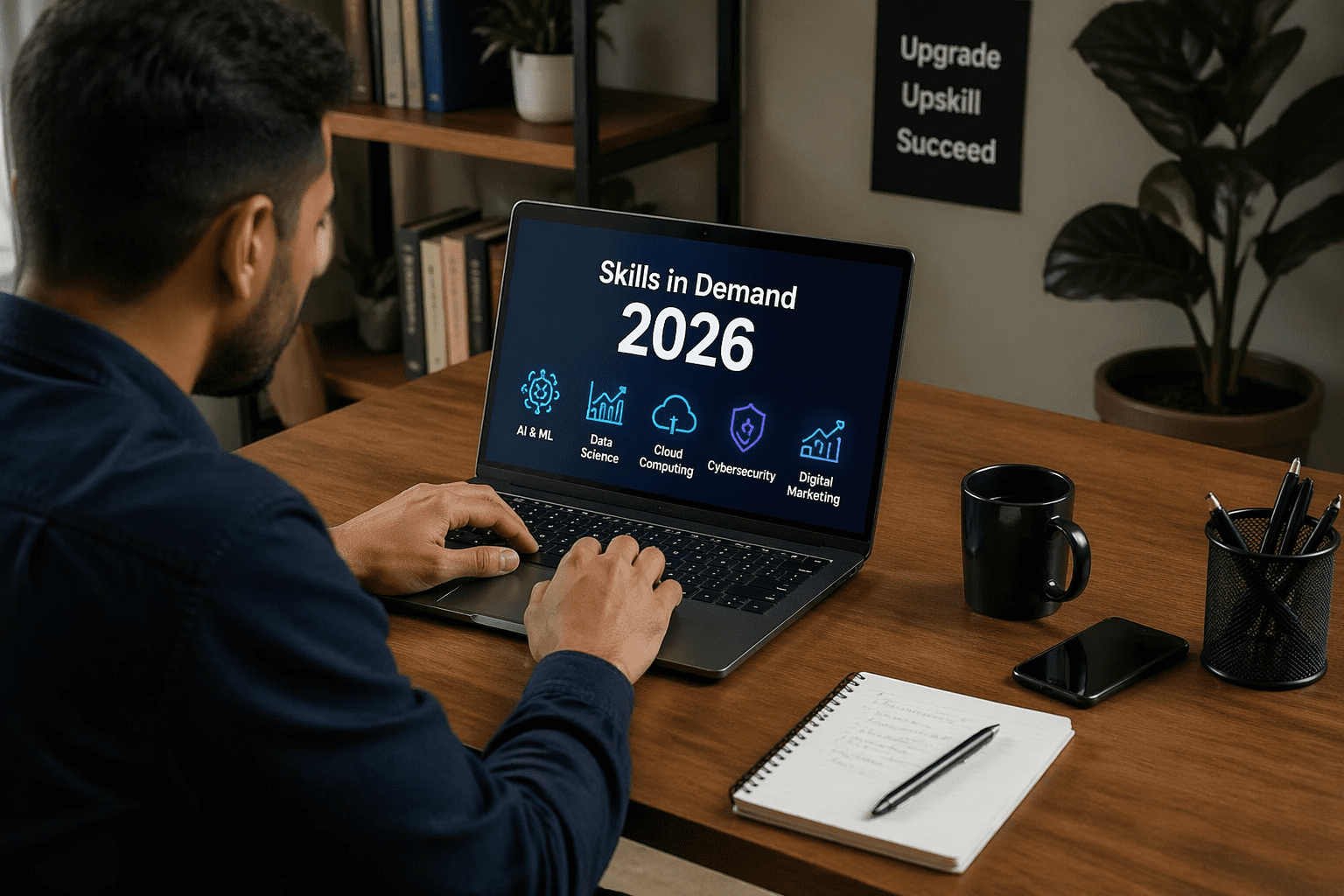
Skills in Demand in 2026: Career Upgrade & Future Jobs
- Posted by GRMI
- Categories Blog, pgdtrm blog
- Date April 21, 2026
Skills in Demand in 2026: Career Upgrade & Future Jobs
Author: Dr.Shalini Kumar
This blog explores how careers in 2026 are shifting from traditional roles to continuous skill upgrades. It covers key areas like cybersecurity and risk management, performance marketing, SEO and AI-driven discovery, content creation, and professional communication. It also highlights structured pathways like GRMI’s PG Diploma in Technology Risk Management, combining classroom learning with industry exposure.
Skills in Demand in 2026: Why Careers Are Being Upgraded, Not Replaced
“Oh my God! I got selected in a Big 4!”
“I got direct admission into Harvard university!”
“I finally got a job in the US with a work visa!”
These are often seen as major success milestones in today’s world.
But there is another side that is equally common today:
“I got fired, now I don’t know what to do next.”
“I quit at 23 due to a toxic work culture.”
“I completed my MBA from a top B-school, but I am still struggling to get ROI.”
Both narratives exist in today’s job market. And both are real
Careers today are no longer defined by entry points, but by continuous skill evolution.
The Biggest Myth About 2026 Careers
A common assumption is that new technology is replacing old skills.
That is not entirely correct.
The reality is:
Skills are not disappearing- But the Skills are being upgraded
Think of it this way:
A risk analyst, a marketer, or a finance professional still exists today—but their tools, expectations, and working environment have completely changed.
So the real question is not “Which career should I choose?”
It is “How quickly can I upgrade my skills?”
So, let’s have a look at some popular career options that have been in demand for many years.
1. Digital Marketing: From Search Rankings to Digital Presence Building
Earlier, digital marketing was mainly about Google ranking, keywords, and backlinks.
Today, it has evolved into a much broader ecosystem:
- AI-driven search visibility
- Content across multiple platforms
- Brand storytelling and trust-building
- Video-first communication strategies
For example, a brand today is not discovered only through Google search. It is discovered through AI summaries, videos, social content, and community discussions.
Digital marketing is no longer just marketing.
It is digital influence building across ecosystems.
2. Cybersecurity & Risk Management: The Backbone of Modern Business
Imagine a banking system or a payment app going down due to a cyberattack.
The impact is immediate:
- Financial losses
- Customer data breach
- Operational disruption
- Loss of trust
This is why cybersecurity and risk management have become one of the fastest-growing domains globally.
Key areas include:
- Cyber risk management
- Information security governance
- Enterprise Risk Management (ERM)
- Compliance and regulatory frameworks
This is also where structured programmes like GRMI’s in collaboration with NIIT- PG Diploma in Technology Risk Management (PGDTRM) become highly relevant.
What makes PGDTRM unique?
- 6 months on-campus learning + 6 months industry internship
- Industry-driven curriculum aligned with real corporate risk roles
- Specialised modules including Cyber Risk, Operational Risk, Financial Risk, and Technology Risk
- Exposure to real-world case studies and enterprise frameworks
- Direct industry interface with professionals from consulting and risk functions
Unlike traditional academic courses, this structure focuses on job-ready capability, not just theory.
It prepares learners for real corporate risk environments from day one.
3. Content & Media Skills: From Creation to AI-Augmented Communication
Content creation is no longer limited to writing or posting.
Today, professionals work with:
- AI-assisted writing tools
- Short-form video content
- Multi-platform storytelling
- Automated content optimisation
However, the key point remains:
AI enhances execution, but creativity still drives impact.
The demand is shifting towards professionals who can combine storytelling + tools + strategy.
4. Performance & Growth Marketing: From Digital Marketing to Outcome-Driven Execution
Earlier, marketing was mainly focused on building online presence through content, branding, and basic promotional activities.
Today, it has evolved into a more performance-driven approach, where the focus is on measurable business results rather than just visibility.
This includes:
Running paid campaigns on platforms like Google and Meta
Generating qualified leads for businesses
Tracking conversions and cost per acquisition
Optimising campaigns based on performance data
For example, instead of just focusing on how many people saw an advertisement, companies now evaluate how many of them actually became customers or took a desired action.
Because of this shift, marketing is now closely linked with data analysis and ROI-based decision making.
Performance & Growth Marketing focuses on turning marketing efforts into measurable business outcomes.
5. Professional Skills: The Hidden Career Growth Factor
Beyond technical roles, one of the most important career accelerators is professional visibility and communication.
Two professionals with the same qualification may have very different outcomes:
- One remains invisible
- One builds authority through consistent communication and clarity of thought
Career growth today depends on:
- How clearly you communicate ideas
- How effectively you present expertise
- How consistently you adapt to industry changes
This is not a job skill—it is a career multiplier.
6. Risk, Audit & Governance: Stability in a Changing World
Risk, audit, and compliance remain one of the most stable and structured career domains.
Key roles include:
- Risk Analyst
- Internal Auditor
- Compliance Specialist
- Enterprise Risk Manager
These roles are built on frameworks, governance systems, and regulatory structures.
Unlike trend-based careers, this domain offers long-term stability and structured progression, especially in banking, consulting, fintech, and corporate sectors.
The Core Truth for 2026
The biggest misunderstanding in today’s job market is thinking that:
- New skills replace old skills
The reality is:
- Skills evolve, they do not disappear.
- AI is an enabler, not a replacement
- Every industry is becoming digital and data-driven
- Adaptability is more important than qualification
Conclusion
Careers in 2026 will not belong to those who simply choose the “right job”. Instead, success will depend on how consistently individuals upgrade their skills, understand industry changes, and adapt to evolving tools and systems. The ability to combine domain knowledge with modern technologies and remain flexible in uncertain environments will define long-term career growth. In today’s world, careers are no longer linear paths; they are continuous upgrades that require ongoing learning and adaptation.
FAQ's
Yes, traditional careers are still relevant, but they are evolving. Roles in finance, marketing, risk, and operations now require updated digital tools, analytical thinking, and continuous skill development.
No, AI is not replacing jobs entirely. It is changing how work is done by automating repetitive tasks. Human roles are still essential for decision-making, strategy, creativity, and risk management.
Domains such as cybersecurity, risk management, audit, compliance, and governance are expected to remain stable due to increasing regulatory and operational complexity across industries.
Cybersecurity has become one of the most critical career domains due to increasing cyber threats, data breaches, and digital fraud across industries. As organisations become more technology-driven, the need to secure systems, data, and operations is growing rapidly. This has created strong demand for professionals in cyber risk and information security roles. Structured programmes like GRMI’s-NIIT collab PG Diploma in Technology Risk Management (PGDTRM) help bridge this gap by combining classroom learning with real industry exposure, preparing learners for practical cybersecurity and risk-related roles.
The most important skill is adaptability. Professionals who continuously upgrade their skills, understand industry changes, and combine domain expertise with modern tools will remain highly relevant in the evolving job market.
You may also like

Best Post Diploma Courses in India for 2026

Best IT Diploma Courses with Highest Job Demand in 2026