

Start Finance Career After Graduation Without MBA
- Posted by GRMI
- Categories Blog, pgdrm blog
- Date April 2, 2026
Start Finance Career After Graduation Without MBA
Breaking into finance without an MBA might seem challenging, but it is far more achievable than it appears today. This blog walks you through how the right mix of fundamentals, practical skills, internships, and consistent effort can open real opportunities. It also addresses common challenges graduates face and shows how a structured path like GRMI PGDRM can help turn confusion into clear career direction with strong outcomes.
How to Start a Career in Finance After Graduation (Without MBA)
Starting a career in finance after graduation without an MBA is entirely achievable when the right strategy, consistent effort, and structured learning approach are followed carefully. The finance industry today is no longer restricted to traditional qualifications and instead increasingly values practical skills, analytical ability, and real-world readiness from candidates.
Graduates are now assessed based on their technical knowledge, certifications, and hands-on experience rather than only academic degrees in most modern hiring processes. A clear, focused, and disciplined roadmap significantly increases the chances of entering the finance industry successfully without pursuing an MBA degree.
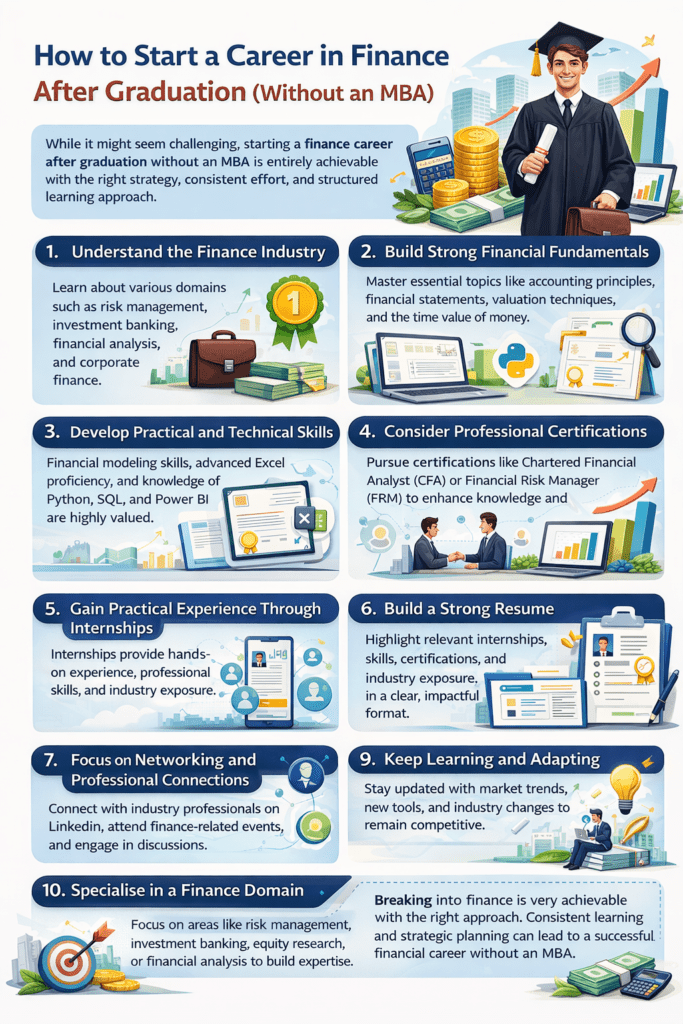
Understanding the Finance Industry
The finance industry offers a wide range of career opportunities across domains such as risk management, investment banking, financial analysis, and corporate finance roles. Each domain requires a unique combination of technical skills, analytical thinking, and strong conceptual understanding of financial and business environments.
Understanding these career paths at an early stage helps graduates choose a direction aligned with their interests, strengths, and long-term professional goals effectively.
Clarity in career direction allows focused preparation and prevents confusion during the initial phase of building a finance career successfully.
Build Strong Financial Fundamentals
A strong understanding of financial fundamentals is absolutely essential for building a successful and sustainable career in the finance industry.
Core concepts such as accounting principles, financial statements, valuation techniques, and time value of money must be thoroughly understood and practised regularly.
These fundamental concepts act as the backbone for advanced financial topics and practical applications used across various finance roles globally.
Consistent revision and continuous application of these concepts help in developing strong conceptual clarity and improving analytical thinking over time.
Develop Practical and Technical Skills
Employers increasingly prefer candidates who possess practical, job-ready skills along with strong theoretical knowledge in finance.
Financial modelling is considered one of the most critical skills required across investment banking, equity research, consulting, and corporate finance roles.
Advanced proficiency in Excel is essential for performing financial analysis, building models, and making data-driven financial decisions efficiently and accurately.
Learning additional tools such as Python, SQL, and Power BI significantly enhances analytical capabilities and improves overall job readiness for candidates.
Learn Industry-Standard Tools
Modern finance roles heavily depend on technology, data analysis, and automation tools used across organisations worldwide today.
Tools such as Excel, Power BI, and programming languages like Python are widely used for analysing financial data and generating insights.
Understanding how to handle large datasets and interpret results helps in making informed, data-driven financial decisions in professional environments.
Candidates with technical proficiency and tool-based knowledge are often preferred over those who rely only on theoretical understanding.
Consider Professional Certifications
Professional certifications play a crucial role in enhancing knowledge, credibility, and employability in the finance industry for graduates without an MBA.
Certifications such as Chartered Financial Analyst and Financial Risk Manager are globally recognised and highly valued by employers across industries.
These certifications provide structured learning, in-depth knowledge, and practical insights into financial concepts and real-world industry applications.
Completing such certifications demonstrates dedication, discipline, and a strong commitment towards building a long-term and successful finance career.
Gain Practical Experience Through Internships
Practical exposure is extremely important for understanding how financial concepts are applied in real business environments and organisations.
Internships provide hands-on experience and help in developing workplace skills, professional behaviour, and industry understanding effectively.
Working on live projects allows candidates to apply theoretical knowledge and build confidence in handling financial tasks independently.
Even short-term internships add significant value to a resume and greatly improve the chances of securing full-time job opportunities.
Build a Strong Resume
A well-structured and professionally designed resume is essential for making a strong and positive impression on recruiters and hiring managers.
The resume should clearly highlight relevant skills, certifications, internships, and achievements in a concise and easy-to-read format.
Including measurable results and quantifiable achievements makes the resume more impactful and helps demonstrate real value to potential employers.
Customising the resume according to specific job roles increases the chances of selection and shows attention to detail and effort.
Focus on Networking and Professional Connections
Networking is a powerful strategy for discovering opportunities and building a successful career in the competitive finance industry.
Platforms like LinkedIn allow graduates to connect with industry professionals, recruiters, and experts in a structured and accessible manner.
Actively engaging with industry-related content and discussions helps in building visibility and establishing a strong professional presence online.
Many job opportunities are accessed through referrals and professional connections rather than traditional job applications alone in today’s market.
Prepare for Interviews
Interview preparation is a critical step in securing a finance role and demonstrating suitability for the position effectively.
Candidates are evaluated based on their technical knowledge, problem-solving ability, and analytical thinking during interview rounds.
Case studies and practical questions are often used to assess real-world application of financial concepts and decision-making abilities.
Regular practice, preparation, and mock interviews help in improving confidence, clarity, and overall communication skills under pressure.
Develop Soft Skills
Soft skills are equally important as technical skills when building a successful and sustainable career in the finance industry.
Effective communication enables candidates to present ideas clearly and explain complex financial concepts in a simple and understandable manner.
Teamwork, adaptability, and professionalism are highly valued in corporate environments and contribute significantly to career growth and success.
Strong interpersonal skills help in building relationships, improving collaboration, and enhancing overall workplace performance over time.
Stay Consistent and Disciplined
Consistency and discipline are essential qualities required to achieve success in a finance career without an MBA qualification.
Following a structured study plan ensures that important topics are covered systematically and understood thoroughly with proper revision.
Daily efforts and continuous learning help in building strong knowledge and improving skills gradually over time with practice.
A disciplined approach ensures steady progress and helps in achieving long-term career goals in a structured and effective manner.
Keep Learning and Adapting
The finance industry is dynamic and continuously evolving with new technologies, regulations, and global market trends influencing its growth.
Continuous learning is essential to stay updated with industry developments and remain competitive in the evolving job market environment.
Adapting to new tools, technologies, and methodologies enhances efficiency and helps in maintaining relevance in professional roles.
Lifelong learning ensures long-term career growth and supports success in an ever-changing financial landscape.
Specialise in a Finance Domain
Specialising in a specific domain helps in building expertise and improving career opportunities in the competitive finance industry.
Fields such as risk management, investment banking, equity research, and financial analysis are highly sought after across organisations globally.
Specialisation allows deeper understanding of specific roles and enhances knowledge in a focused and structured manner.
Employers value candidates with specialised skills as they bring strong domain expertise and practical understanding to their roles.
Build Analytical Thinking
Analytical thinking is a core skill required for making informed and effective financial decisions in professional environments.
Finance professionals must analyse data, evaluate risks, and identify opportunities using logical reasoning and structured approaches.
Strong analytical skills help in interpreting complex financial data and supporting strategic decision-making processes within organisations.
These skills can be developed through continuous practice, case studies, and real-world problem-solving exercises over time.
Stay Updated with Market Trends
Staying updated with market trends is important for understanding the current financial environment and making informed decisions.
Following financial news, reports, and global developments helps in building awareness of economic changes and industry movements.
Market knowledge improves analytical abilities and enhances decision-making skills in professional finance roles significantly over time.
Regular observation and learning help in developing a deeper understanding of financial systems and market behaviour.
Why Is It Difficult to Do This Alone?
If you are wondering how all these steps can be achieved together, you are not alone in this journey at all.
Many graduates face challenges due to lack of guidance, structured learning, and practical exposure while entering the finance industry.
Without a clear pathway, it becomes difficult to connect theoretical knowledge with real-world applications and industry expectations.
A structured and guided learning approach is often required to bridge this gap effectively and efficiently for better outcomes.
GRMI PGDRM Programme
The GRMI Post Graduate Diploma in Risk Management is designed for graduates who want to build a career in finance and consulting without pursuing an MBA. The programme focuses on practical learning, industry exposure, and skill development aligned with real corporate expectations.
It bridges the gap between academic learning and industry requirements through a structured and career-focused approach.
Key Deliverables of GRMI PGDRM
Strong placement record with 97% placements across leading organisations including Deloitte, EY, and KPMG, ensuring excellent career outcomes.
Industry-focused curriculum designed to build practical skills in risk management, finance, and consulting aligned with current market demands.
Exposure to live projects, case studies, and expert-led sessions that prepare students for real-world corporate challenges and decision-making scenarios
Conclusion
A finance career without an MBA can be successfully built with the right approach, dedication, and consistent effort over time.
Skills, practical exposure, certifications, and continuous learning play a crucial role in achieving success in the finance industry today. With proper guidance and a structured roadmap, graduates can build strong careers and achieve their professional goals effectively.
The right programme and support can significantly accelerate this journey and help in achieving long-term success in finance careers.
FAQ's
Yes, a finance career can be started without an MBA by developing skills, gaining practical experience, and building a strong professional profile.
Skills such as financial analysis, Excel proficiency, problem-solving, data analysis, and communication are highly important in finance roles.
Certifications are not mandatory but significantly improve knowledge, credibility, and overall job opportunities in competitive finance markets today.
Yes, internships provide practical exposure, help in skill development, and increase employability in finance careers effectively.
Focus on building fundamentals, learning technical tools, gaining certifications, and pursuing internships to build a strong finance career.
You may also like

Risk Appetite vs Risk Tolerance: Guide for 2026

Best 1-Year Courses After Graduation in 2026

