
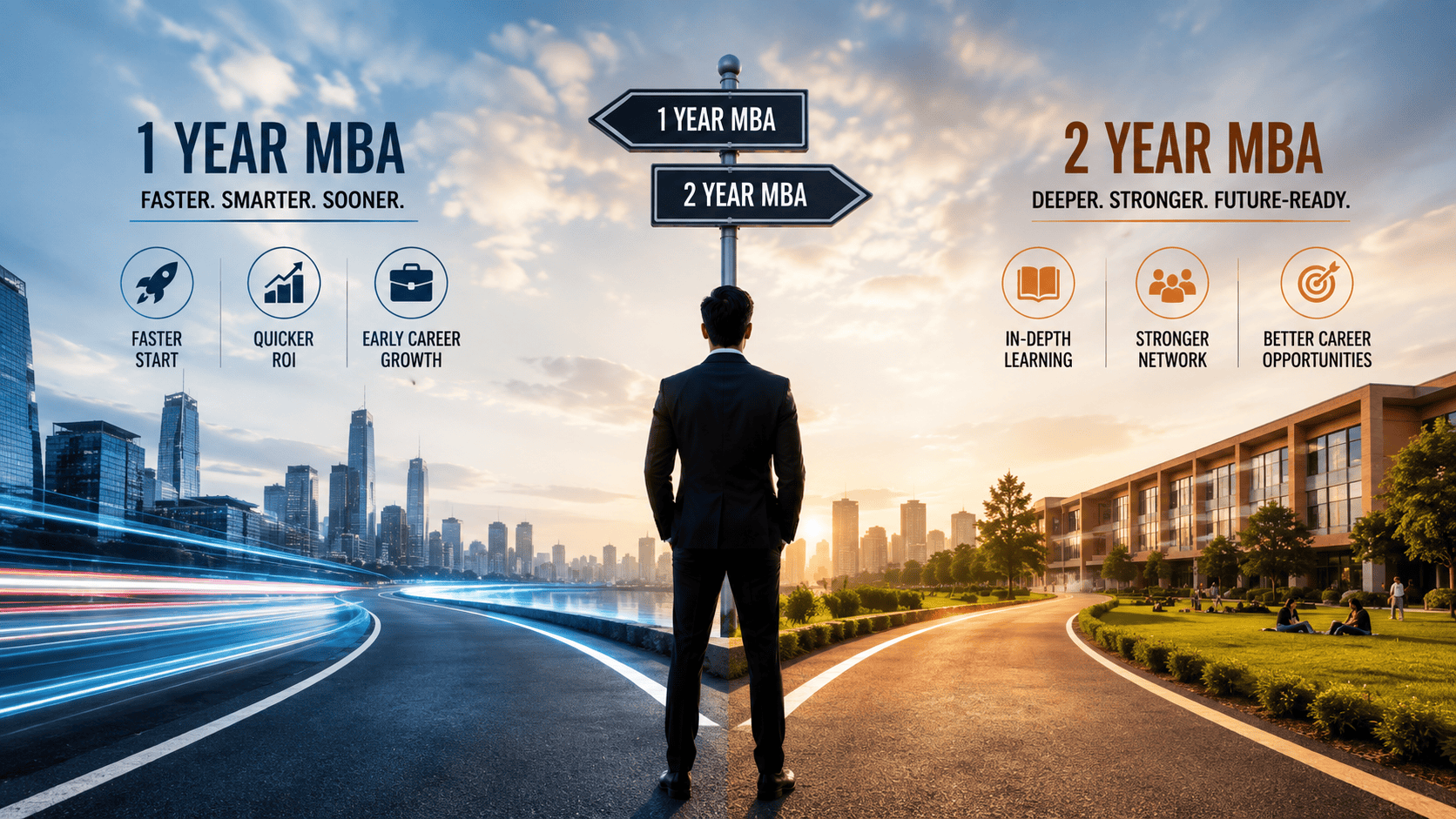
1 Year MBA vs 2 Year MBA: Which Is Better for Your Career?
- Posted by GRMI
- Categories Blog, pgdrm blog
- Date August 3, 2026
1 Year MBA vs 2 Year MBA: Which Is Better for Your Career?
Jump to ↓
Overview
This guide explains the differences between a 1 year MBA and a 2 year MBA in India, covering duration, eligibility, costs, internships, career outcomes, ROI, and factors to consider before choosing the right programme.
Author: Anjori Gupta
Introduction
Choosing between a one-year and a two-year Master of Business Administration (MBA) is one of the biggest career decisions for professionals in India. The one-year MBA vs two-year MBA debate is not about which option is better overall; it is about selecting the option that best matches your work experience, financial situation, career goals, and learning expectations.
This guide explains the key differences between both MBA formats to help you understand which path may be the right fit for your career journey.
What Is the Real Difference Between a 1 Year MBA and a 2 Year MBA?
The difference between a one-year MBA and a two-year MBA goes beyond the duration of the programme. Factors such as target audience, learning approach, internship opportunities, and career objectives play an important role in deciding which format is more suitable.
Duration and pace:
A one-year MBA covers the complete curriculum within 11–12 months, making it a fast-paced and intensive learning experience. A two-year MBA spreads the curriculum across four semesters, allowing more time for academic learning, internships, projects, and campus activities.
Target audience:
One-year MBA programmes, such as the Post Graduate Programme (PGP) at the Indian School of Business (ISB), are generally designed for professionals with around 2–5 or more years of work experience. Two-year MBA programmes offered by institutions such as the Indian Institutes of Management (IIMs) mainly cater to fresh graduates and early-career professionals.
Internship:
Two-year MBA programmes usually include a compulsory summer internship between the first and second year. This provides students with valuable industry exposure and often helps them enter fields such as consulting, banking, and product management. Most one-year MBA programmes do not include a formal internship due to their shorter duration.
Degree name:
Many Indian two-year MBA programmes award a Post Graduate Diploma in Management (PGDM), while some one-year programmes use different qualification names. However, employers generally evaluate these programmes based on the reputation of the institute, curriculum, alumni network, and career outcomes.
Who Should Choose the 1 Year MBA Route?
A one-year MBA is generally suitable for professionals who already have work experience and want to accelerate their careers without taking an extended break from employment.
It can be a suitable option for:
- Working professionals who want to develop advanced business skills while spending less time away from work.
- Candidates with 3+ years of experience who have clear career objectives and want to move into managerial or leadership roles.
- Professionals focused on return on investment, as returning to work sooner can reduce the opportunity cost of studying.
- Individuals looking for career progression within their existing industry rather than a complete career transition.
Since one-year MBA programmes are intensive, they usually provide limited time for internships and extended recruitment processes.
Who Should Choose the 2 Year MBA Route?
A two-year MBA is often better suited for fresh graduates and professionals at the beginning of their careers who want broader exposure and time to explore different career opportunities.
It can be a good choice for:
- Freshers and candidates with 0–2 years of experience who want to develop strong business fundamentals.
- Career switchers who want structured opportunities to explore new industries through internships and placements.
- Students looking for a wider learning experience with electives, live projects, networking opportunities, and campus activities.
- Candidates who value long-term brand recognition and alumni networks.

How Do Costs and Return on Investment Compare?
When comparing a one-year MBA and a two-year MBA, students should consider both direct costs and the opportunity cost of leaving employment.
Tuition fees:
A one-year MBA at a leading Indian business school may cost around ₹20–42 lakh, while two-year MBA programmes at leading institutions generally range between ₹15–25 lakh, depending on the institute.
Opportunity cost:
Students pursuing a two-year MBA spend two years away from full-time employment, whereas one-year MBA students typically lose only one year of potential earnings.
Placement outcomes:
The Graduate Management Admission Council’s (GMAC) Corporate Recruiters Survey highlights continued employer demand for MBA graduates, while also showing the increasing importance of technology and artificial intelligence (AI)-related skills alongside business knowledge.
Domestic hiring trends:
As employer expectations continue to evolve, selecting the right specialisation and developing relevant skills have become increasingly important for MBA graduates.
Which Programme Offers Better Brand Recognition?
The value of an MBA depends largely on the reputation of the institution rather than only the duration of the programme.
- Global recognition: One-year programmes such as ISB’s PGP have gained international recognition through global rankings.
- National recognition: Flagship two-year MBA programmes from institutions such as IIM Ahmedabad, IIM Bangalore, and IIM Kozhikode continue to hold strong positions in Indian management education.
- Recruiter perception: Both formats attract leading employers across consulting, technology, banking, and other sectors. However, established two-year programmes often have wider recognition among fresh graduates.
Ultimately, the institute’s reputation, curriculum, alumni network, and career outcomes matter more than the length of the programme.
Can Specialised Programmes Offer Focused Career Learning?
While an MBA provides broad knowledge across multiple areas of business management, some professionals prefer specialised programmes that focus on a specific industry or career function.
Specialised programmes can help learners develop:
Domain expertise
Industry-relevant skills
Practical knowledge
Functional understanding of specific career areas
For individuals interested in areas such as risk management, compliance, governance, and financial services, specialised education can provide a focused pathway aligned with industry requirements.
GRMI’s PGDRM: A Specialised Learning Pathway in Risk Management
The Post Graduate Diploma in Risk Management (PGDRM) by the Global Risk Management Institute (GRMI) is designed for graduates and professionals who want to develop expertise in risk management, compliance, governance, and business strategy.
Unlike a general management programme that covers multiple business functions, PGDRM focuses specifically on risk-related domains through:
Financial risk management
Operational risk management
Enterprise risk management
Governance and compliance
Business strategy
This 12 months programme combines 10 months classroom learning with 2 months practical exposure through case studies, industry interactions, workshops, and internship opportunities.
PGDRM graduates have explored opportunities with organisations across consulting, banking, financial services, and technology sectors, including firms such as Deloitte, EY, KPMG, PwC, and other leading organisations, depending on recruitment requirements and individual eligibility.
So, Which One Should You Pick?
The choice between a one-year and two-year MBA depends on your current career stage and future goals.
Choose a one-year MBA if you:
Have relevant work experience.
Want faster career progression.
Have a clear professional direction.
Choose a two-year MBA if you:
Are a fresher or early-career professional.
Want internship exposure.
Need more time to explore different career options.
Choose a specialised programme if you:
Want expertise in a specific domain.
Prefer industry-focused learning.
Want to build skills aligned with a particular career path.
The right choice should be based on your career aspirations, learning requirements, and long-term goals rather than only the duration of the programme.
Quick Comparison: 1 Year MBA vs 2 Year MBA
Feature | 1 Year MBA | 2 Year MBA |
Duration | 11–12 months | 2 academic years |
Best suited for | Professionals with 2–5+ years of experience | Freshers and candidates with 0–2 years of experience |
Internship | Usually not included | Mandatory summer internship |
Career goal | Career growth within the same field | Career launch or industry transition |
Time away from work | One year | Two years |
Opportunity cost | Lower | Higher |
Learning experience | Fast-paced and intensive | More gradual and flexible |
Typical qualification | PGP or MBA equivalent | PGDM or MBA equivalent |
Examples | ISB PGP | IIM Ahmedabad, IIM Bangalore, IIM Kozhikode |
Conclusion
Choosing a management course for quick employment is not just about selecting a recognised qualification. The right programme should help students develop practical skills, gain industry exposure, and understand how their learning applies to real-world business challenges.
Industry-oriented programmes can provide students with a combination of classroom learning, internships, live projects, and industry interactions, helping them become better prepared for the workplace. However, the value of any programme ultimately depends on its curriculum, faculty, practical exposure, industry connections, and placement outcomes.
Before making a decision, graduates should carefully evaluate these factors and choose a programme that aligns with their career goals, learning preferences, and long-term professional aspirations.
FAQ's
Yes, especially when pursued from a reputed institution. However, most one-year MBA programmes require prior work experience, making two-year programmes more suitable for fresh graduates.
The tuition fee of a one-year MBA may be similar to or higher than a two-year MBA. However, the shorter duration reduces the salary loss associated with taking time away from work.
Most leading one-year MBA programmes require prior professional experience, so fresh graduates are generally better suited for two-year MBA programmes.
A PGDRM can prepare graduates for opportunities in areas such as risk management, consulting, financial services, compliance, enterprise risk, technology risk, and corporate risk across industries including banking, consulting, technology, and other corporate organisations.
Yes. Specialised programmes can help learners gain focused knowledge and practical skills in specific domains. Programmes such as GRMI’s PGDRM can support career pathways in risk management, consulting, financial services, governance, and related areas.
Student Voices, Real Impact

Saoumita Chatterjee
It gave me opportunities that no MBA college could. With exceptional ROI and exposure to the Big 4, it's a game-changer for freshers.

Saurav Nath
My search for an education institute stopped at GRMI as it helped me become a risk intelligent professional and successfully secure placement.

Yash Nagaich
From day one, the faculty support at GRMI helped me strengthen my fundamentals and prepare for a successful career.

Sarthak Kapoor
The industry-focused curriculum and faculty guidance helped me apply risk and audit concepts effectively during interviews and beyond.

Aditya Ghosh
The industry-focused curriculum and placement support helped me build confidence and successfully secure my placement.

Anzar Mehboob Berg
The mix of hands-on learning, industry exposure, and faculty mentorship helped me transition smoothly into my career through placements.

Jayita Gulati
Learning directly from industry experts gave me a practical perspective that proved invaluable during the placement process.

Shashank Modi
The opportunity to learn from both academic experts and industry leaders played a key role in helping me begin my career with a leading organization.

Tanya Wadhwa
With continuous mentor guidance and excellent placement support, I was well-prepared to handle interviews confidently.
Saoumita Chatterjee
It gave me opportunities that no MBA college could. With exceptional ROI and exposure to the Big 4, it's a game-changer for freshers.
Saurav Nath
My search for an education institute stopped at GRMI as it helped me become a risk intelligent professional and successfully secure placement.
Yash Nagaich
From day one, the faculty support at GRMI helped me strengthen my fundamentals and prepare for a successful career.
Sarthak Kapoor
The industry-focused curriculum and faculty guidance helped me apply risk and audit concepts effectively during interviews and beyond.
Aditya Ghosh
The industry-focused curriculum and placement support helped me build confidence and successfully secure my placement.
Anzar Mehboob Berg
The mix of hands-on learning, industry exposure, and faculty mentorship helped me transition smoothly into my career through placements.
Jayita Gulati
Learning directly from industry experts gave me a practical perspective that proved invaluable during the placement process.
Shashank Modi
The opportunity to learn from both academic experts and industry leaders played a key role in helping me begin my career with a leading organization.
Tanya Wadhwa
With continuous mentor guidance and excellent placement support, I was well-prepared to handle interviews confidently.
You may also like

Risk Appetite vs Risk Tolerance: Guide for 2026

Best 1-Year Courses After Graduation in 2026

