
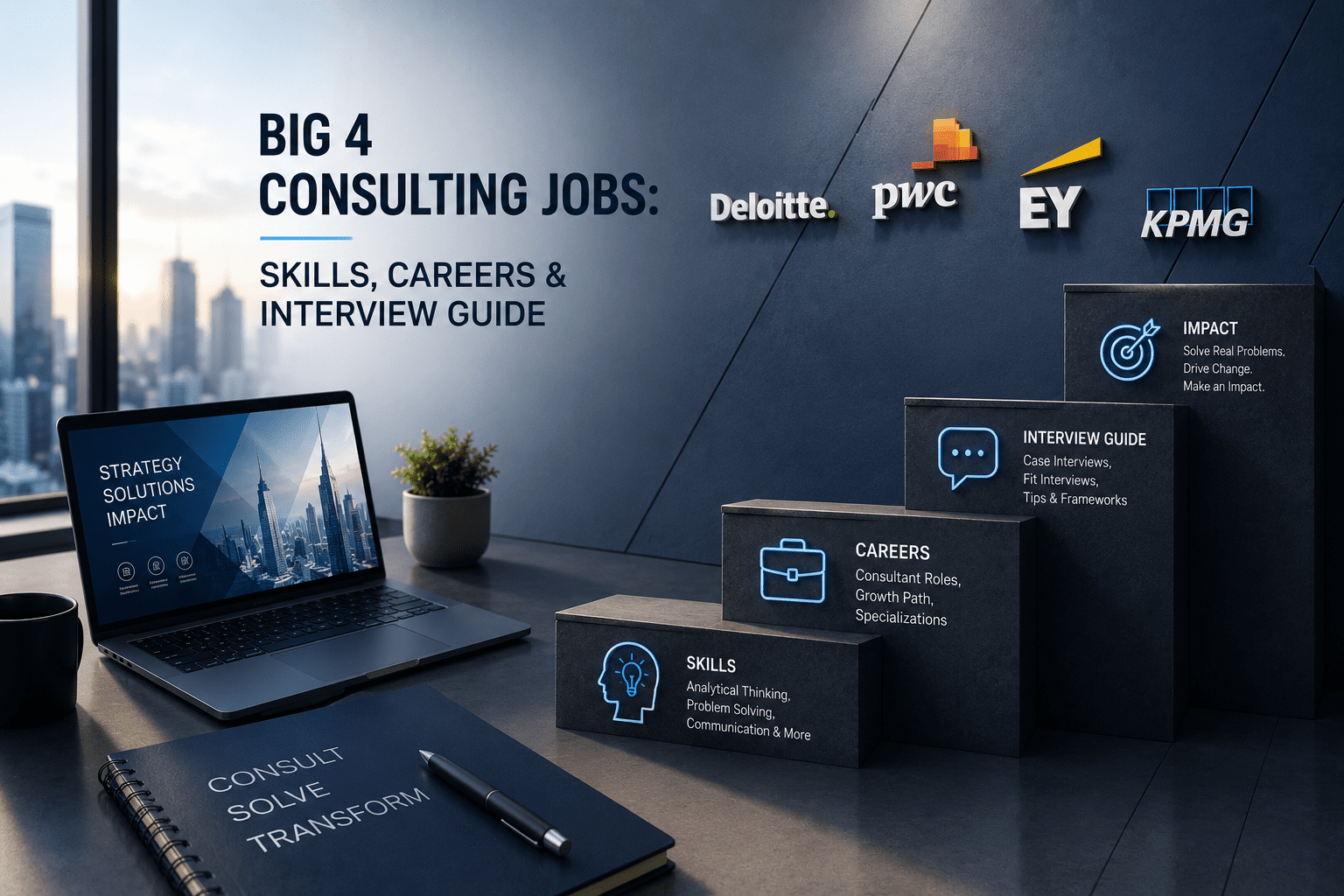
Big 4 Consulting Jobs: Skills, Careers and Interview Guide
- Posted by GRMI
- Categories Blog, pgdrm blog
- Date June 17, 2026
Big 4 Consulting Jobs: Skills, Careers & Interview Guide
Jump to ↓
Overview
This blog is a complete guide for aspiring candidates aiming to build a career in top consulting firms such as Deloitte, PwC, EY, and KPMG. It covers essential skills, qualifications, and preparation strategies needed to succeed in competitive consulting roles. The article also highlights what recruiters expect beyond academic performance, including problem-solving ability, communication skills, and business awareness, helping candidates improve their employability and interview readiness.
Skills and Qualifications Required for Big 4 Consulting Roles
Big 4 consulting firms such as Deloitte, PwC, EY, and KPMG continue to attract ambitious graduates seeking careers in consulting, risk management, technology advisory, and business transformation. For students wondering how to land a job in Big 4 firms, developing the right combination of technical expertise, business knowledge, communication skills, and professional qualifications is essential.
Every year, these firms receive thousands of applications from talented candidates. However, securing a role requires much more than a strong academic record. Employers are increasingly looking for professionals who can combine analytical thinking, business understanding, communication skills, and practical problem-solving abilities.
If you are aspiring to build a career in consulting, understanding the skills and qualifications required for Big 4 consulting roles can help you prepare effectively and stand out during the recruitment process.
Understanding Big 4 Consulting Roles
Consulting professionals help organisations solve business challenges, improve processes, manage risks, adopt new technologies, and achieve strategic goals.
Depending on the service line, consultants may work on:
- Business transformation projects
- Risk management and compliance initiatives
- Technology implementation
- Cybersecurity assessments
- Operational improvement programmes
- Financial and regulatory consulting
- Data analytics and business intelligence
Because consulting projects span multiple industries and functions, employers seek candidates with a broad skill set rather than expertise in a single area.
Technical Skills Required for Big 4 Consulting Roles
Technical knowledge forms the foundation of a successful consulting career.
1. Business and Financial Understanding
Consultants frequently work with business leaders to solve organisational challenges. A strong understanding of finance, accounting, economics, and business operations helps professionals evaluate problems from a commercial perspective.
Key areas include:
- Financial statement analysis
- Business strategy
- Corporate governance
- Cost management
- Risk assessment
- Regulatory compliance
Candidates with commerce, management, finance, economics, or risk management backgrounds often possess a strong foundation for consulting careers.
2. Data Analysis Skills
Data-driven decision-making has become central to modern consulting.
Big 4 firms increasingly rely on professionals who can interpret data and identify actionable insights. Familiarity with analytical tools can significantly improve employability.
Useful skills include:
- Microsoft Excel
- Power BI
- Tableau
- SQL
- Python
- Data visualisation
The ability to convert complex data into meaningful business recommendations is highly valued across consulting teams.
3. Risk Management and Compliance Knowledge
As regulatory requirements continue to evolve, organisations require guidance on managing operational, financial, and strategic risks.
Understanding areas such as:
- Enterprise Risk Management (ERM)
- Internal controls
- Governance frameworks
- Regulatory compliance
- Operational risk
- Cybersecurity risk
can provide a strong advantage when applying for risk consulting and advisory roles.
4. Technology Awareness
Technology is transforming how organisations operate. Consultants are expected to understand emerging technologies and their business implications.
Knowledge of the following areas can strengthen a candidate’s profile:
- Cloud computing
- Artificial Intelligence (AI)
- Cybersecurity
- Automation
- Digital transformation
- Enterprise Resource Planning (ERP) systems
Even non-technical consultants benefit from understanding how technology impacts business performance and risk management.
Essential Soft Skills for Consulting Careers
While technical expertise is important, consulting is fundamentally a people-oriented profession.
Communication Skills
Consultants regularly interact with clients, senior executives, and project teams.
Strong communication skills help professionals:
- Present recommendations clearly
- Conduct stakeholder interviews
- Facilitate workshops
- Prepare reports and presentations
- Build client relationships
The ability to explain complex concepts in simple terms is often what differentiates top-performing consultants.
Problem-Solving Ability
One of the most important skills required for Big 4 consulting roles is structured problem-solving.
Consultants must:
- Identify root causes
- Analyse information objectively
- Evaluate alternatives
- Develop practical solutions
Recruiters frequently assess these capabilities through case interviews and business problem-solving exercises.
Critical Thinking
Consultants are expected to challenge assumptions and evaluate situations from multiple perspectives.
Critical thinking enables professionals to:
- Interpret data effectively
- Identify hidden risks
- Assess business impacts
- Make informed recommendations
This skill becomes increasingly valuable as professionals progress into senior consulting roles.
Adaptability and Learning Agility
Consulting projects vary significantly across industries and clients.
One week, a consultant may be supporting a financial services organisation; the next, they may be advising a technology company.
The ability to learn quickly, adapt to change, and remain effective in unfamiliar situations is essential.
Teamwork and Collaboration
Most consulting engagements involve working within diverse project teams.
Successful consultants demonstrate:
- Collaboration
- Professionalism
- Emotional intelligence
- Stakeholder management
- Leadership potential
Employers seek candidates who can contribute effectively while also supporting team success.
Qualifications That Strengthen Your Consulting Profile
While there is no single educational path into consulting, certain qualifications can enhance career prospects.
Common academic backgrounds include:
- Commerce
- Business Administration
- Economics
- Finance
- Engineering
- Technology
- Risk Management
Professional certifications can also add value, including:
- CFA
- FRM
- PMP
- ACCA
- Risk management certifications
- Data analytics certifications
However, employers often place equal importance on practical skills, internships, project experience, and leadership activities.
Understanding how to land a job in Big 4 firms goes beyond academic qualifications alone. Employers increasingly look for candidates who can combine analytical thinking, structured problem-solving, and practical business awareness to deliver meaningful client impact.
How GRMI's PGDRM Can Help Build Consulting Skills
For students interested in consulting, risk advisory, governance, and business strategy, specialised education can help bridge the gap between academic learning and industry requirements.
The Post Graduate Diploma in Risk Management (PGDRM) offered by GRMI is designed to develop many of the competencies sought by consulting employers.
The programme focuses on areas such as:
- Enterprise Risk Management
- Governance and Compliance
- Business Analytics
- Financial Risk
- Operational Risk
- Strategic Decision-Making
- Emerging Business Risks
These subjects help students build analytical, business, and risk management capabilities that are increasingly relevant across consulting and advisory functions.
In addition to technical knowledge, exposure to industry projects, case studies, and practical business scenarios can help students develop the structured thinking and problem-solving skills required in consulting environments.
Final Thoughts
Building a successful consulting career requires a combination of technical expertise, business awareness, communication skills, and continuous learning.
The skills and qualifications required for Big 4 consulting roles continue to evolve as organisations face new business challenges, technological disruption, and increasing regulatory expectations.
Candidates who develop strong analytical capabilities, understand business fundamentals, stay informed about industry trends, and invest in relevant professional education will be better positioned to succeed in the competitive consulting landscape.
Whether your goal is to work in strategy, risk advisory, business consulting, or technology consulting, developing these capabilities early can significantly improve your long-term career prospects.
FAQ's
Big 4 consulting firms typically look for analytical thinking, problem-solving abilities, communication skills, business understanding, teamwork, and adaptability, alongside relevant technical knowledge.
No. Candidates from commerce, management, engineering, economics, technology, and other disciplines can build successful consulting careers, provided they develop relevant business and analytical skills.
Case interviews are commonly used to assess problem-solving, structured thinking, communication, and decision-making abilities. Strong preparation can significantly improve interview performance.
Data analytics, financial analysis, risk management, business strategy, and technology awareness are among the most valuable technical skills for consulting careers.
GRMI’s PGDRM helps students develop expertise in risk management, governance, business analytics, and strategic decision-making, which are increasingly relevant across consulting and advisory roles.
You may also like

Risk Appetite vs Risk Tolerance: Guide for 2026

Best 1-Year Courses After Graduation in 2026

