How the Risk Management Process Works: Steps & Framework
- Posted by GRMI
- Categories Blog, pgdrm blog
- Date August 21, 2026
How the Risk Management Process Works: Steps & Framework
Jump to ↓
Author: Anjori Gupta
What does the risk management process actually involve? This blog explains each stage, from identifying and assessing risks to treating, reporting and monitoring them. It also covers the proper order of the process, the risk management cycle, key frameworks, a practical business example and how risk management knowledge applies across different functions.
Risk Management Process: Steps, Framework & Examples
Every business takes risks. A company may launch a new product, enter a new market, depend on a supplier, invest in technology or make a major financial decision without knowing exactly what will happen next. The goal of risk management is not to eliminate every risk. Instead, it is to understand what could go wrong, assess its potential impact and take informed action.
A risk management process provides a structured way to do this. It helps organisations identify potential risks, evaluate their likelihood and impact, decide how to respond, communicate important risk information and continuously monitor changes.
A well-defined process can help businesses protect their assets, support better decision-making, strengthen resilience and respond to emerging risks more effectively. The process is also continuous: once a risk has been assessed and treated, it still needs to be monitored because its likelihood, impact or underlying conditions can change.
What Is the Risk Management Process?
The risk management process is a systematic approach organisations use to identify, assess, respond to, report and monitor risks that could affect their objectives.
It begins by recognising potential risks and understanding what could cause them. The organisation then evaluates the likelihood and potential impact of those risks before deciding whether they should be avoided, reduced, transferred or accepted.
However, the process does not end after a response is implemented. Risks need to be monitored regularly, controls need to be reviewed and new risks need to be identified as business conditions change.
In simple terms, the risk management process can be represented as:
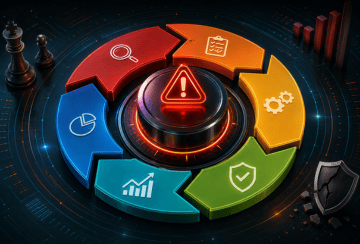
Identify → Assess → Respond → Report → Monitor → Review
This creates a continuous cycle rather than a one-time activity.

What Are the Steps or Explain the Risk Management Process?
While organisations may adapt the process according to their industry, objectives and risk framework, a practical five-step approach includes:
- Risk identification
- Risk assessment
- Risk mitigation or treatment
- Risk reporting and communication
- Risk monitoring and review
These stages are closely connected. The information gathered during one stage influences the decisions made in the next. For example, an organisation cannot select an appropriate response until it understands the nature and significance of the risk.
1. Identify the Risk
The first step in risk management is risk identification.
Before an organisation can decide how to manage a risk, it needs to understand what risks it may face. These can arise from internal operations as well as external developments.
Common sources of risk include:
- Changes in regulations or government policies
- Market volatility
- Cybersecurity incidents
- Operational failures
- Supply chain disruptions
- Financial instability
- Human error
- Technology failures
- Reputational issues
- Strategic decisions
Risk identification may involve reviewing historical data, conducting interviews and workshops, analysing business processes, monitoring key indicators, studying industry developments and using scenario analysis.
For example, a company that depends heavily on a single supplier may identify supplier dependency as a potential supply chain risk. The risk may not have caused a disruption yet, but the dependence itself creates an exposure that should be assessed.
Effective identification is important because an organisation cannot manage a risk that it has not recognised.
2. Assess the Risk
Once risks have been identified, the next step is to determine how significant each risk is.
Risk assessment generally considers two key factors:
- Likelihood: How likely is the risk to occur?
- Impact: What could happen if the risk materialises?
Organisations can use qualitative, quantitative or combined approaches to assess risk. A qualitative assessment may classify risks as low, medium or high based on predefined criteria. Quantitative assessment can use numerical or financial measures to estimate potential exposure.
A risk matrix is another commonly used tool. It helps organisations compare risks according to their likelihood and potential impact so that higher-priority risks receive appropriate attention.
For example, suppose a company identifies a potential cybersecurity breach. If the likelihood is considered high and the potential financial, operational and reputational impact is also significant, the risk may receive a higher priority than a low-impact operational issue.
Risk assessment therefore helps answer an important question:
Which risks require the most immediate attention?
3. Mitigate or Treat the Risk
After assessing risks, organisations need to decide what to do about them.
The appropriate response depends on factors such as the organisation’s risk appetite, the potential impact of the risk, the cost of controls and the extent to which the risk can realistically be reduced.
Common risk treatment strategies include:
Risk avoidance:
Changing a business activity or decision to remove the risk altogether.
Risk reduction:
Introducing controls or changing processes to reduce the likelihood or impact of the risk.
Risk transfer:
Moving some or all of the financial consequences of a risk to another party, such as through insurance or contractual arrangements.
Risk acceptance:
Choosing to retain the risk when it falls within the organisation’s risk appetite and the cost of reducing it may outweigh the potential benefit.
For example, if a company considers its dependence on one supplier too risky, it could reduce the exposure by developing relationships with alternative suppliers. It could also maintain additional inventory to reduce the impact of a temporary disruption.
The objective is not necessarily to bring every risk to zero. Instead, the objective is to bring risks to a level that the organisation is prepared and able to manage.
4. Report and Communicate the Risk
Risk management is not limited to the risk team. Decision-makers across an organisation need relevant risk information to make informed choices.
Risk reporting communicates important information such as:
- Major or emerging risks
- Risk exposure
- Risk ratings
- Key risk indicators (KRIs)
- Control effectiveness
- Changes in risk levels
- Mitigation or treatment plans
The information shared may differ depending on the audience. Senior management and boards, for example, may need a high-level view of the organisation’s most significant risks, while operational teams may require more detailed information about specific controls and actions.
Effective communication ensures that important risks do not remain isolated within one department.
5. Monitor and Review the Risk
The final step is risk monitoring and review.
This is what makes risk management a continuous process.
A risk that was considered low six months ago may become significant because of a change in market conditions, regulations, technology, suppliers or business strategy. Similarly, a control that was previously effective may no longer provide adequate protection.
Regular monitoring helps organisations:
- Track changes in risk exposure
- Check whether controls are working
- Identify emerging risks
- Review mitigation plans
- Detect changes in likelihood or impact
- Take corrective action when required
This stage also feeds information back into the beginning of the process.
If monitoring reveals a new risk or a significant change in an existing risk, the organisation may need to identify, assess and treat the risk again.
What Is the First Step in Risk Management?
The first step in the risk management process is risk identification.
An organisation must first recognise and document potential risks before it can assess their likelihood and impact or decide how to respond to them.
However, identifying a risk does not mean that the risk will definitely occur. It simply means that the organisation has recognised a potential event or condition that could affect its objectives.
For example, a business expanding into a new country might identify currency fluctuations, regulatory changes and supply chain disruption as potential risks before entering the market.
Identify the Proper Order of the Risk Management Process?
The proper order of the risk management process can be summarised as:
- Identify → 2. Assess → 3. Mitigate/Treat → 4. Report → 5. Monitor and Review
The process then loops back as risks change or new risks emerge.
This order matters because each stage builds on the previous one. An organisation needs to identify a risk before it can assess it. It needs to understand the risk before choosing an appropriate response, and it needs monitoring and reporting to determine whether the response remains effective.
That said, risk management should not be viewed as a rigid, one-directional sequence. Monitoring can reveal new information that sends an organisation back to identification or assessment.
What Is the Risk Management Cycle?
The risk management cycle refers to the continuous nature of managing risk.
Unlike a one-time checklist, the cycle recognises that risks can change over time. A business may face new regulations, competitors, technologies, economic conditions or operational challenges that alter its risk profile.
A simplified risk management cycle looks like this:
Identify → Assess → Treat → Monitor → Review → Identify Again
For example, consider a company that identifies a potential supply chain disruption.
It first assesses the likelihood and impact of the disruption. It then develops alternative suppliers and other controls to reduce its exposure. After implementing these measures, it monitors supplier performance and external conditions.
If geopolitical developments later increase the likelihood of disruption, the organisation reassesses the risk and may introduce additional controls.
This continuous feedback loop helps organisations remain prepared as circumstances change.
From Understanding Risk to Applying It Across Business Functions
The risk management cycle also highlights an important aspect of risk management careers: the same fundamental process can be applied to very different types of risks.
A professional assessing financial risk may examine market movements, credit exposure or liquidity. Someone working with technology risk may assess cybersecurity threats, system vulnerabilities or data-related risks. Operational risk professionals may focus on process failures, people or supply chain disruptions.
This is why specialised knowledge can be useful for professionals entering the field. GRMI’s 1-year Post Graduate Diploma in Risk Management (PGDRM) brings together students from different academic and professional backgrounds, providing exposure to risk management concepts that can be applied across business functions and industries.
The programme also has a 97% placement track record, with 400+ alumni placed across organisations including EY, KPMG, Deloitte, PwC, Accenture, Tata Motors, Maruti Suzuki, Titan and American Express. This gives graduates an opportunity to build specialised knowledge while preparing for roles where risk assessment, analysis and decision-making are central to the work.
Risk Management Process vs Risk Management Framework
The terms risk management process and risk management framework are sometimes used interchangeably, but they refer to different things.
The risk management process describes the activities involved in managing risk.
The risk management framework provides the broader structure within which those activities take place. It can define areas such as governance, responsibilities, policies, risk appetite, reporting, methodologies and decision-making.
In simple terms:
Process = What an organisation does to manage risk
Framework = The structure that guides how risk management is organised and governed
Frameworks such as ISO 31000, COSO ERM and NIST’s Risk Management Framework provide different approaches to organising and managing risk. The appropriate framework depends on an organisation’s objectives, industry, regulatory environment and risk profile.
Risk Management Process Example
Consider a company that relies on a single supplier for an important raw material.
Step 1: Identify
The company identifies its dependence on one supplier as a potential supply chain risk.
Step 2: Assess
It evaluates the likelihood of supplier disruption and considers the potential impact on production, revenue and customer commitments.
Step 3: Treat
The company decides to reduce the exposure by developing alternative suppliers and maintaining an appropriate level of inventory.
Step 4: Report
The risk, its current exposure and the planned controls are communicated to relevant management.
Step 5: Monitor
The company regularly reviews supplier performance, inventory levels and external developments. If the supplier’s financial position deteriorates or geopolitical conditions change, the risk is reassessed.
This example demonstrates why risk management is a cycle. The work does not stop once a mitigation plan has been implemented.
Why Is the Risk Management Process Important?
A structured risk management process can support organisations in several ways.
Better Decision-Making
Understanding potential risks gives decision-makers more information before committing resources or pursuing a strategy.
Protection of Business Assets
Risk management can help protect financial resources, data, technology, intellectual property and other critical assets.
Business Continuity
Identifying vulnerabilities and preparing appropriate responses can help organisations respond to disruptions and recover more effectively.
Stronger Governance and Compliance
A defined process creates clearer responsibilities and supports organisations in identifying and responding to regulatory and compliance risks.
Greater Resilience
Continuous monitoring helps organisations recognise changes earlier and adapt their responses as conditions evolve.
Conclusion
Risk management is more than identifying things that could go wrong. It is a structured approach to understanding uncertainty and making informed decisions about how risks should be handled.
The process typically follows five key stages: identify, assess, treat, report and monitor. But the process does not end with monitoring. Changes in the business environment can create new risks or alter existing ones, making regular review essential.
For organisations, the value of a risk management process lies not only in preventing losses but also in creating greater clarity around decisions, strengthening resilience and preparing for uncertainty.
For professionals looking to build careers in this field, understanding how the risk management process, risk assessment, mitigation strategies and risk frameworks work together provides an important foundation for working across areas such as financial risk, operational risk, enterprise risk, technology risk and compliance.
FAQ's
The risk management process is a structured approach used by organisations to identify, assess, treat, report and monitor risks that could affect their objectives. It is a continuous process because risks and business conditions can change over time.
The first step in risk management is risk identification. Organisations first identify potential events or conditions that could affect their objectives before assessing their likelihood, impact and appropriate response.
The five common steps are:
- Risk identification
- Risk assessment
- Risk mitigation or treatment
- Risk reporting and communication
- Risk monitoring and review
The process generally follows this order: Identify → Assess → Treat/Mitigate → Report → Monitor & Review. Since risks can change, monitoring may lead the organisation back to identification and assessment.
A risk management process refers to the activities used to manage risks, such as identification, assessment and monitoring. A risk management framework provides the broader structure that guides these activities, including governance, responsibilities, policies, risk appetite and reporting mechanisms.
Student Voices, Real Impact

Saoumita Chatterjee
It gave me opportunities that no MBA college could. With exceptional ROI and exposure to the Big 4, it's a game-changer for freshers.

Saurav Nath
My search for an education institute stopped at GRMI as it helped me become a risk intelligent professional and successfully secure placement.

Yash Nagaich
From day one, the faculty support at GRMI helped me strengthen my fundamentals and prepare for a successful career.

Sarthak Kapoor
The industry-focused curriculum and faculty guidance helped me apply risk and audit concepts effectively during interviews and beyond.

Aditya Ghosh
The industry-focused curriculum and placement support helped me build confidence and successfully secure my placement.

Anzar Mehboob Berg
The mix of hands-on learning, industry exposure, and faculty mentorship helped me transition smoothly into my career through placements.

Jayita Gulati
Learning directly from industry experts gave me a practical perspective that proved invaluable during the placement process.

Shashank Modi
The opportunity to learn from both academic experts and industry leaders played a key role in helping me begin my career with a leading organization.

Tanya Wadhwa
With continuous mentor guidance and excellent placement support, I was well-prepared to handle interviews confidently.
Saoumita Chatterjee
It gave me opportunities that no MBA college could. With exceptional ROI and exposure to the Big 4, it's a game-changer for freshers.
Saurav Nath
My search for an education institute stopped at GRMI as it helped me become a risk intelligent professional and successfully secure placement.
Yash Nagaich
From day one, the faculty support at GRMI helped me strengthen my fundamentals and prepare for a successful career.
Sarthak Kapoor
The industry-focused curriculum and faculty guidance helped me apply risk and audit concepts effectively during interviews and beyond.
Aditya Ghosh
The industry-focused curriculum and placement support helped me build confidence and successfully secure my placement.
Anzar Mehboob Berg
The mix of hands-on learning, industry exposure, and faculty mentorship helped me transition smoothly into my career through placements.
Jayita Gulati
Learning directly from industry experts gave me a practical perspective that proved invaluable during the placement process.
Shashank Modi
The opportunity to learn from both academic experts and industry leaders played a key role in helping me begin my career with a leading organization.
Tanya Wadhwa
With continuous mentor guidance and excellent placement support, I was well-prepared to handle interviews confidently.
You may also like

Best Post Diploma Courses in India for 2026

Best IT Diploma Courses with Highest Job Demand in 2026