
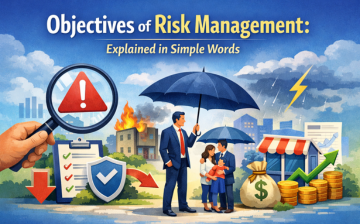
Objectives of Risk Management: Explained in Simple Words
- Posted by GRMI
- Categories Blog, pgdrm blog
- Date December 17, 2025
Objectives of Risk Management: Explained in Simple Words
Risk management is a critical practice for every business, regardless of size or sector. It focuses on identifying, analysing, and mitigating potential threats that could harm an organisation’s capital, earnings, or operations. The primary goal is to anticipate risks in advance and take preventive actions to protect the organisation’s assets and reputation.
To achieve this, businesses implement structured processes that define the objectives of risk management clearly. These objectives include identifying and evaluating risks early, reducing or eliminating harmful threats, ensuring efficient use of resources, improving communication within the organisation, reassuring stakeholders, and supporting continuity and long-term growth.
Every organisation faces risks that may affect productivity, financial stability, or survival. Structured risk management processes help companies monitor threats continuously and make informed decisions. This ensures operations stay on track while providing a safe environment for employees and stakeholders.
Key Objectives of Risk Management
- Identify and Evaluate Risks: The first objective is to detect potential risks early. Organisations analyse historical data, past incidents, and lessons learned. Risk managers assess internal processes, market conditions, and external factors to determine threats. Understanding the root causes allows timely mitigation of adverse effects.
- Reduce or Eliminate Harmful Threats: All businesses face threats that can affect productivity and profitability. Risk management develops strategies to reduce or avoid these risks. Training sessions and workshops educate employees about risk awareness. This knowledge helps prevent incidents and protects resources and staff.
- Support Efficient Use of Resources: Effective risk management ensures resources are used efficiently. By reducing losses and optimising workflows, businesses increase productivity and profits. Risk managers set performance targets, monitor results, and implement corrective actions if deviations occur.
- Improve Communication Within the Organisation: Clear communication is essential for successful risk management. It ensures directors, managers, and employees understand potential risks and mitigation strategies. Sharing risk information promptly fosters collaboration, accountability, and a culture of risk awareness.
- Reassure Stakeholders: Stakeholders play a key role in business success. Risk management builds confidence by showing that threats are monitored and controlled. Demonstrating proactive risk handling strengthens trust with investors, clients, and partners.
- Ensure Organisational Continuity: A core objective is to maintain long-term business continuity. Continuous monitoring of operations helps detect new risks and prevents incidents from escalating. Organisations can maintain stability, reduce uncertainty, and protect profits, even during disruptions.
Essential Steps in Risk Management
- Identify Sources of Risk: Analyse processes, departments, and external factors to uncover threats.
- Analyse Likelihood and Impact: Evaluate how likely risks are and their potential consequences.
- Evaluate and Prioritise Risks: Focus on high-probability, high-impact risks first, while monitoring low-priority risks.
- Implement Mitigation Strategies: Use avoidance, reduction, sharing, or acceptance techniques to manage risks.
- Continuous Monitoring: Regularly reassess risks, evaluate controls, and adjust strategies as business environments change.
Common Risk Management Techniques
- Risk Avoidance: Prevent activities that expose the organisation to unnecessary threats.
- Risk Reduction: Minimise potential impact using safeguards and preventive measures.
- Risk Sharing: Distribute risk among multiple parties through insurance or partnerships.
- Risk Transferring: Outsource functions to reduce internal exposure.
- Risk Acceptance: Recognise unavoidable risks and plan strategies to manage them.
Traditional vs. Enterprise Risk Management (ERM)
Traditional risk management is reactive and focuses on isolated departmental risks. It can be fragmented and inefficient.
Enterprise Risk Management (ERM) adopts a holistic, organisation-wide approach. It considers interactions between different risks and aligns risk management with overall business objectives. ERM encourages cross-department collaboration and proactive response strategies.
Psychological Aspects in Risk Management
Human behaviour affects risk decisions. Biases like overconfidence or loss aversion can lead to errors. Stress and emotions may result in poor evaluation or responses. Regular training, workshops, and a culture of peer review help organisations overcome these challenges.
Leveraging Technology in Modern Risk Management
Technology and AI have transformed risk management. Tools like dashboards, GRC platforms, and cybersecurity software help monitor threats in real time. AI analyses large datasets to detect patterns and predict risks. These solutions enable faster, more accurate decisions and improve organisational resilience.
GRMI-PGDRM: Bridging Risk Management and Technology
The GRMI-PGDRM is a leading risk management course designed to develop practical skills in risk governance, compliance, and strategic decision-making. It blends business risk insight with real-world applications.
The programme focuses on:
- Fundamentals of risk identification, assessment, and mitigation
- Enterprise risk governance and policy design
- Compliance, legal frameworks, and standards
- Business continuity planning and crisis response
- Practical exposure through labs and a two-month paid internship
This risk management course prepares students for key roles such as:
- Risk Manager: Leads risk assessment, response planning, and monitoring.
- Risk Analyst: Evaluates risk data to support strategic decisions.
- Compliance Officer: Ensures adherence to laws, standards, and policies.
- Business Continuity Manager: Maintains operations during disruptions.
- Enterprise Risk Consultant: Advises organisations on risk frameworks and performance improvement.
By combining strategy with practical experience, graduates strengthen governance, improve compliance, and sustain performance.
Click the video below to explore more insights:
Conclusion
Risk management is essential for business survival, stability, and growth. Its objectives include identifying threats, reducing harmful effects, ensuring resource efficiency, improving communication, reassuring stakeholders, and supporting continuity.
Structured processes, modern tools, and a proactive mindset make risk management effective. The GRMI-PGDRM risk management course equips professionals to manage governance, compliance, and enterprise risks confidently. Mastering these skills enables businesses and individuals to navigate uncertainties and achieve long-term success.
FAQ's
Q1. What is the main goal of risk management?
Ans: To identify, assess, and mitigate potential risks to protect business assets and operations.
Q2. Why is continuous monitoring important?
Ans: It ensures timely detection of new risks and verifies the effectiveness of existing controls.
Q3. How does ERM differ from traditional risk management?
Ans: ERM takes a holistic, organisation-wide approach rather than focusing on isolated departmental risks.
Q4. What are common techniques used in risk management?
Ans: Risk avoidance, reduction, sharing, transferring, and acceptance.
Q5: What does the PGDRM programme focus on?
Ans: PGDRM emphasises practical risk management, strategic decision-making, and enterprise risk governance skills.
For any queries, please fill out the form
You may also like

Risk Appetite vs Risk Tolerance: Guide for 2026

Best 1-Year Courses After Graduation in 2026

