
Risk Analysis Explained: Types, Process & Best Practices Guide
- Posted by GRMI
- Categories Blog, pgdrm blog
- Date June 20, 2026
Risk Analysis Explained: Types, Process & Best Practices Guide
Jump to ↓
Author: Jayant palan
This guide explains risk analysis in detail, covering its types, approaches, process, and best practices. It helps organisations understand, evaluate, and manage risks effectively for better decision-making and long-term resilience.
Navigating Uncertainty: An Introduction to Risk Analysis
Every organisation must manage risk to protect its operations and needs a clear understanding of those risks and their potential impacts. That is why many companies rely on risk analysis to assess and identify potential risks to their business operations. Risk analysis is essential as it ensures organisations make informed decisions and respond to risks effectively.
Risk Analysis: An Overview
Risk analysis is a process that falls under the broader framework of risk management. It involves determining the potential consequences of various risks, their likelihood of occurrence, and the overall threat they pose to an organisation.
Conducting regular risk analysis allows organisations to develop contingency plans, thereby reducing the likelihood of unexpected factors affecting their objectives. It also enables them to design countermeasures to address risks as they emerge.
It is important to note that risk analysis differs from risk assessment. Risk assessment identifies potential threats and vulnerabilities, whereas risk analysis focuses on evaluating those identified risks in terms of their impact and likelihood. This enables organisations to prioritise risks and develop appropriate strategies.
What is Risk Analysis?
Risk analysis is a structured process used to evaluate risks by assessing their likelihood and potential impact. It helps organisations understand what could go wrong and how severely it could affect operations.
For example, a company may analyse the risk of a cyberattack by assessing both the probability of occurrence and the potential financial and operational consequences.
Risk analysis does not eliminate risk; instead, it helps organisations manage uncertainty in a structured and informed way.
Types of Risk Analysis
Risk-Benefit Analysis
This approach evaluates the potential benefits of a decision against its associated risks, helping organisations determine whether a strategy is worth pursuing.
Business Impact Analysis
This method assesses the potential disruption caused by events such as natural disasters or system failures, helping organisations plan recovery strategies and minimise downtime.
Needs Assessment Analysis
A structured method used to identify gaps in operations and determine areas requiring improvement, enabling better allocation of resources.
Delphi Method
A structured communication technique where experts provide anonymous feedback through multiple rounds of questionnaires until a consensus is reached, reducing bias in decision-making.
Root Cause Analysis
This method focuses on identifying the underlying causes of a problem to prevent recurrence and improve long-term risk control.
Approaches to Risk Analysis
Risk analysis is generally conducted using two main approaches: qualitative and quantitative.
Qualitative risk analysis relies on expert judgement and descriptive evaluation rather than numerical data. It helps identify risks and understand their nature. Examples include SWOT analysis and risk interviews.
Quantitative risk analysis uses numerical data and statistical models to measure probability and impact. Techniques include Monte Carlo simulations and historical data analysis.
Most organisations combine both approaches to ensure a more comprehensive and balanced risk evaluation.
Steps to the Risk Analysis Process
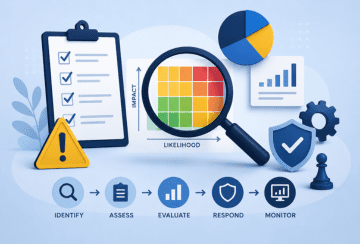
- Identify risks: Compile potential risks using brainstorming, historical data, and industry research.
- Assess likelihood and impact: Evaluate each risk based on probability and severity.
- Prioritise risks: Rank risks using matrices or scoring systems to focus on the most critical threats.
- Develop response plans: Create mitigation strategies and assign responsibilities.
- Monitor and review: Continuously track risks and update analysis as conditions change.
At this stage, structured professional learning also plays a key role. Programmes such as Post Graduate Diploma in Risk Management (PGDRM) offered by GRMI help learners understand real-world risk frameworks used in organisations
Best Practices for Risk Analysis
- Combine qualitative and quantitative methods for balanced insights
- Involve diverse stakeholders to reduce bias
- Maintain consistent documentation of all risk-related processes
- Align analysis with organisational objectives
- Regularly review and update risk assessments
- Assign clear ownership for each identified risk
Final Words
Risk analysis is a vital component of modern risk management. It helps organisations convert uncertainty into structured insights, enabling better decision-making and resource allocation.
However, no single method can capture every risk completely. As markets evolve and organisations grow, new risks continue to emerge. Therefore, risk analysis must be an ongoing and adaptive process that is regularly reviewed and refined to ensure long-term resilience.
FAQ's
Risk analysis is the process of identifying potential risks, assessing their likelihood, and evaluating their impact on an organisation’s operations and objectives.
The main purpose of risk analysis is to help organisations make informed decisions by understanding possible threats and preparing effective strategies to manage them.
Risk assessment identifies potential risks, while risk analysis evaluates those risks in detail by studying their likelihood and impact.
The main types include risk-benefit analysis, business impact analysis, needs assessment analysis, Delphi method, and root cause analysis.
Risk analysis uses two key approaches: qualitative (based on expert judgement and descriptive insights) and quantitative (based on numerical and statistical data).
It helps organisations reduce uncertainty, prioritise risks, improve decision-making, and ensure better preparedness for potential disruptions.
Risk analysis should be carried out regularly and updated whenever there are changes in business operations, market conditions, or external risks.
You may also like

Risk Appetite vs Risk Tolerance: Guide for 2026

Best 1-Year Courses After Graduation in 2026

