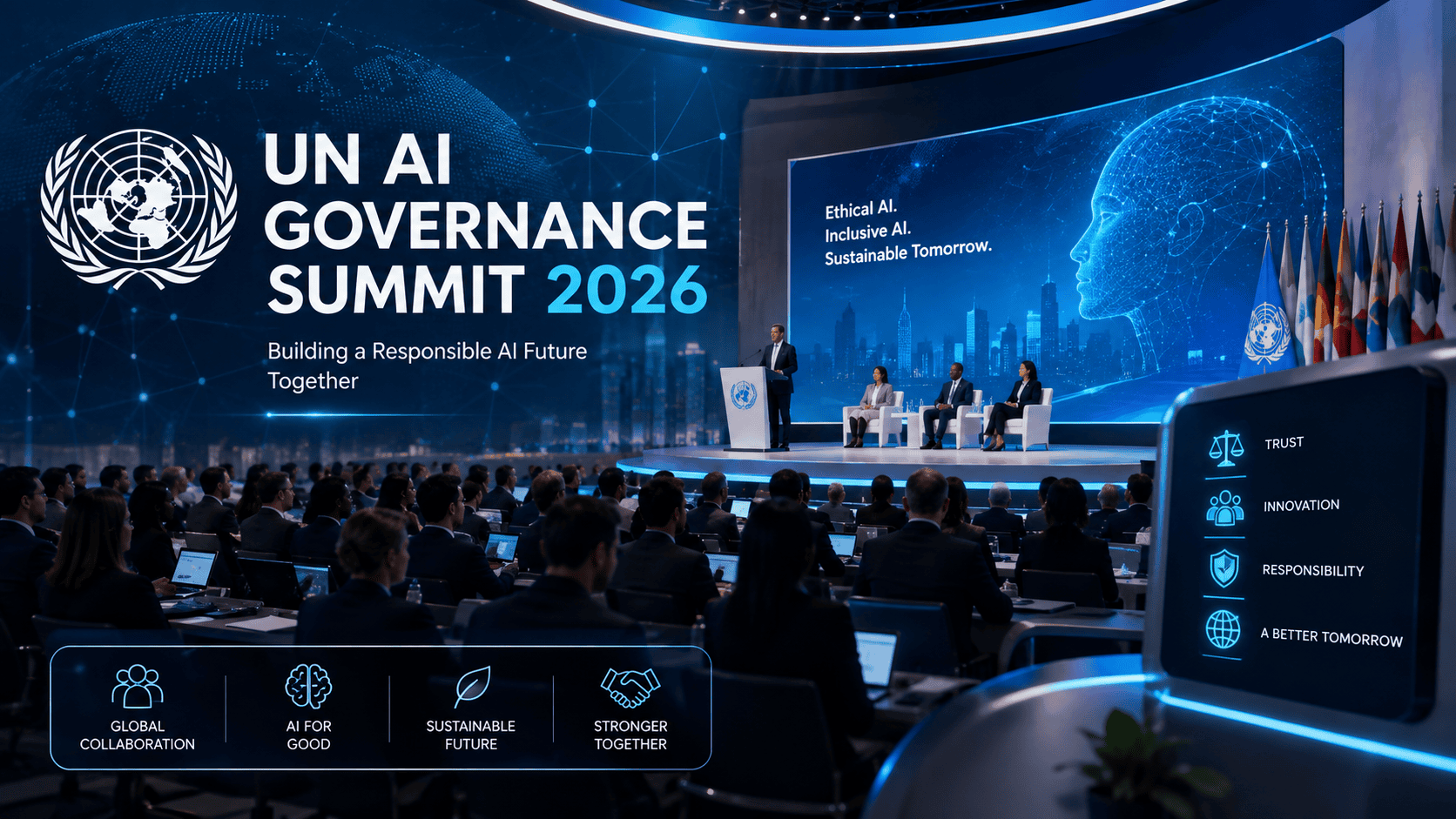
UN AI Governance Summit 2026: Key Highlights and Takeaways

- Posted by GRMI
- Categories Blog, pgdrm blog
- Date August 7, 2026
UN AI Governance Summit 2026: Key Highlights and Takeaways
Jump to ↓
Author: Anjori Gupta
Introduction
On 6-7 July 2026, the United Nations held its first ever Global Dialogue on Artificial Intelligence (AI) Governance in Geneva, Switzerland. For the first time, all 193 member states met with technology companies, researchers, and civil society groups to discuss how AI should be governed worldwide. For risk professionals, this was more than a diplomatic event. It showed that AI oversight is moving from voluntary company policies to international cooperation and cross border compliance.
This blog explains what happened at the summit and what it means for enterprise risk management (ERM) in India and around the world.
What Happened at the UN Global Dialogue on AI Governance?
- A first for global AI diplomacy: All 193 United Nations member states, together with technology companies, academics, and civil society groups, met to discuss AI for the first time, with the talks co-chaired by the Permanent Representatives of El Salvador and Estonia.
- A strong scientific warning: Days before the summit, an independent UN scientific panel warned that AI is advancing faster than governments can understand or regulate it, and that there is still no guarantee advanced AI systems will always follow human instructions.
- A divide between major powers: The United States, which controls about three quarters of the computing power behind the world’s leading AI supercomputers, questioned centralised global AI rules, highlighting differences over international and national approaches.
- A call to act from the UN chief: Secretary General António Guterres said AI could become one of this century’s greatest equalisers, but only if systems are tested for safety and legal responsibility is clearly defined before they are deployed.
Why Should Companies Care About a UN Summit?
A UN summit may seem far removed from a company’s quarterly risk register, but the issues discussed in Geneva directly affect the risks that businesses already manage every day.
- Reputational risk: Public trust in AI is still fragile, and companies seen as using AI irresponsibly can suffer lasting damage to their reputation.
- Compliance risk: Governments are turning summit level ideas into binding laws, from the European Union’s AI Act to India’s developing AI governance framework.
- Operational risk: AI failures, including biased outputs and automation mistakes, can disrupt business operations long before regulators take action.
- Third party and vendor risk: Most companies buy AI instead of building it themselves, meaning weaknesses in a vendor’s AI system can quickly become the customer’s risk.
What Global AI Risk Trends Should Every Business Track?
- Rising incident rates: Stanford University’s AI Index Report recorded 362 AI related incidents in 2025, up 55 percent from 233 incidents in 2024, showing that AI risks are becoming more common.
- Governance brings financial value: PwC research shows that much of AI’s economic value goes to the smaller group of organisations that invest heavily in governance and responsible AI systems.
- Regulatory penalties are increasing: Under the European Union’s AI Act, breaking rules for high-risk AI systems can lead to fines of up to €15 million or 3 percent of global turnover.
- Security gaps remain significant: IBM data shows many organisations have already experienced breaches involving AI systems, with most affected organisations lacking proper access controls.
How Is India Responding to the Global Push on AI Governance?
India has been developing its own AI governance framework alongside the UN process, and the two are becoming increasingly aligned.
- The Seven Sutras framework: The Ministry of Electronics and Information Technology (MeitY) released the India AI Governance Guidelines in November 2025, based on seven guiding principles that support innovation while encouraging responsible oversight.
- Sector regulators are taking action: The Reserve Bank of India (RBI) released draft Model Risk Management guidance in June 2026, covering AI and machine learning models used by banks, Non-Banking Financial Companies (NBFCs), and other regulated financial institutions.
- Data protection is now enforceable: The Digital Personal Data Protection Act (DPDPA), 2023 is now in force and applies to any AI system that handles the personal data of Indian citizens, including software purchased from overseas vendors.
- An internationally recognised benchmark: ISO/IEC 42001, the global standard for AI management systems, has been adopted as a Bureau of Indian Standards (BIS) national standard and is already appearing in enterprise tender requirements.
What Does This Mean for Future Risk Professionals?
As AI governance frameworks continue to evolve, organisations need professionals who can understand both regulatory expectations and enterprise risk management practices.
This growing focus is increasing demand for expertise in areas such as governance, risk and compliance (GRC), enterprise risk management (ERM), technology risk, regulatory compliance, and AI governance.
For graduates and working professionals looking to build expertise in these domains, industry-oriented programmes such as the Post Graduate Diploma in Risk Management (PGDRM) at GRMI provide practical exposure through case studies, industry-led learning, and internship opportunities, helping learners develop skills aligned with the evolving needs of the risk management profession.
How Can Companies Build AI Oversight Into Their Risk Management Framework?
- Map AI use cases to business risks: Classify every AI tool by the ERM risk category it affects, such as operational, compliance, reputational, or cyber, instead of treating AI as a single risk.
- Assign clear responsibility: Clearly decide who owns AI risk, as Deloitte’s 2026 CFO Signals survey found that about one-third of surveyed Chief Financial Officers (CFOs) said AI governance is currently handled by the Chief Information Security Officer (CISO) by default.
- Adopt recognised standards: Aligning with ISO/IEC 42001 and the United States National Institute of Standards and Technology (NIST) AI Risk Management Framework gives boards and regulators a trusted benchmark.
- Strengthen vendor due diligence: Because most enterprise AI risks come from purchased software, vendor contracts should require proof of the supplier’s own AI governance practices.
- Maintain audit-ready records: Using a lifecycle approach, from risk assessment and approval to deployment and ongoing monitoring, helps organisations prove that controls are working rather than simply assumed.
Conclusion
The UN AI Governance Summit 2026 highlights a major shift in how organisations will approach artificial intelligence. As AI adoption continues to grow, businesses will need stronger frameworks to manage risks related to compliance, cybersecurity, data protection, operational resilience, and responsible AI usage.
For organisations, the priority will not only be adopting AI technologies but also ensuring that these systems are transparent, accountable, and aligned with evolving regulatory expectations.
For risk professionals, this transformation creates new opportunities while also increasing the need for specialised knowledge across areas such as enterprise risk management, governance, compliance, technology risk, and AI governance.
FAQ's
It is the first United Nations platform where all 193 member states, together with companies, academics, and civil society groups, meet to discuss international cooperation on AI safety, accountability, and governance.
Not directly. The Dialogue is a platform for building international agreement rather than making laws, but its discussions are already influencing binding national and regional rules such as the European Union’s AI Act and India’s MeitY guidelines.
It is the first international standard for AI management systems, helping organisations demonstrate structured and auditable AI governance. It has also been adopted as a national standard by the Bureau of Indian Standards (BIS).
Companies using AI in India must already comply with the Digital Personal Data Protection Act (DPDPA), 2023, sector specific rules from regulators such as the RBI, and MeitY’s Seven Sutras guidelines, even though the guidelines are not yet a standalone law.
Student's Experience in GRMI

Yash Nagaich
After a year in banking, I decided to change my career path. Global Risk Management Institute attracted me with its niche, high-demand course, offering practical exposure and insights that helped me build skills and secure my target job.
Placement: Okta
PGDRM July Batch 2024-25

Sarthak Kapoor
My experience at GRMI was enriching. The practical curriculum and expert faculty simplified risk concepts and helped me build strong fundamentals, analytical skills, and professional confidence for risk management roles.
Placement: EY
PGDRM July Batch 2024-25

Aditi Rathee
My experience with GRMI was very positive. The course built practical risk management skills, supportive faculty guided me well, and the internship offered real-world exposure that boosted my confidence and long-term career readiness.
Placement: RSM
PGDRM July Batch 2024-25

Yash Nagaich
After a year in banking, I decided to change my career path. Global Risk Management Institute attracted me with its niche, high-demand course, offering practical exposure and insights that helped me build skills and secure my target job.
Placement: Okta
PGDRM July Batch 2024-25

Sarthak Kapoor
My experience at GRMI was enriching. The practical curriculum and expert faculty simplified risk concepts and helped me build strong fundamentals, analytical skills, and professional confidence for risk management roles.
Placement: EY
PGDRM July Batch 2024-25

Aditi Rathee
My experience with GRMI was very positive. The course built practical risk management skills, supportive faculty guided me well, and the internship offered real-world exposure that boosted my confidence and long-term career readiness.
Placement: RSM
PGDRM July Batch 2024-25
You may also like

Big 4 Recruitment for Freshers in India: Complete Guide


