What is Risk Mitigation? Process, Strategies, and Best Practices
- Posted by GRMI
- Categories Blog, pgdrm blog
- Date June 15, 2026
What is Risk Mitigation? Process, Strategies, and Best Practices
Jump to ↓
Author: Jayant palan
Risk mitigation is the process of identifying, assessing, and reducing the impact of potential risks that could affect an organization. By implementing proactive strategies and controls, businesses can minimize disruptions, protect assets, ensure operational continuity, and strengthen resilience against unexpected challenges.
What is Risk Mitigation? Process, Strategies, and Best Practices
Organizations today operate in an increasingly complex business environment where risks can emerge from various sources, including cyberattacks, operational failures, economic uncertainty, regulatory changes, and natural disasters. While it is impossible to eliminate every threat, businesses can take proactive measures to minimize their impact. This is where risk mitigation becomes essential.
Risk mitigation helps organizations prepare for uncertainty by identifying potential threats and implementing strategies to reduce their likelihood or consequences. A well-designed risk mitigation plan not only protects business operations but also strengthens resilience and supports long-term growth.
What is Risk Mitigation?
Risk mitigation is the process of identifying, assessing, and implementing measures to reduce the likelihood or impact of potential risks. It is a key component of risk management and helps organizations prepare for threats that could disrupt operations, cause financial losses, or damage their reputation.
Rather than attempting to eliminate every risk, risk mitigation focuses on understanding potential threats and taking practical steps to minimize their effects. These threats may include cybersecurity incidents, supply chain disruptions, equipment failures, compliance issues, natural disasters, or operational challenges.
For example, a company may regularly maintain its machinery to reduce the risk of unexpected breakdowns. While maintenance cannot completely eliminate equipment failure, it can significantly reduce the chances of disruption and lower repair costs if an issue occurs.
Why is Risk Mitigation Important?
Every organization faces risks that are beyond its direct control. Without a structured approach to managing these risks, businesses can experience significant financial, operational, and reputational consequences.
Risk mitigation is important because it helps organizations:
- Reduce the impact of unexpected events
- Improve business continuity and operational resilience
- Protect employees, assets, and business processes
- Support informed decision-making
- Strengthen regulatory and compliance readiness
- Improve stakeholder confidence
- Minimize financial losses and operational disruptions
By proactively planning for potential threats, organizations can respond more effectively when challenges arise and ensure that business objectives remain on track.
The Risk Mitigation Process
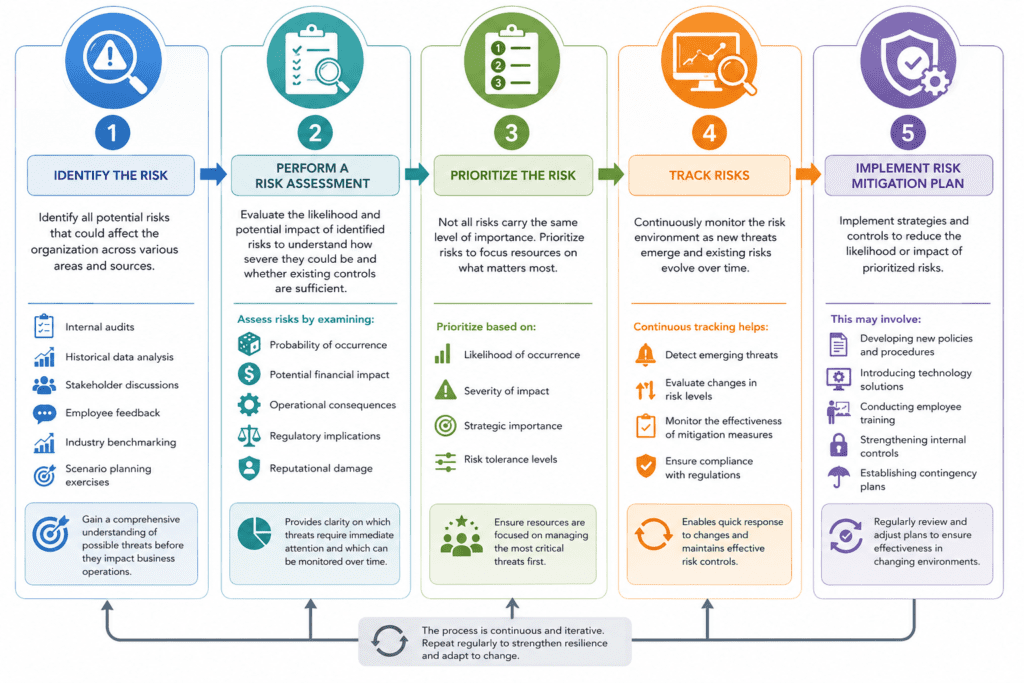
An effective risk mitigation framework follows a structured process that enables organizations to identify, assess, prioritize, and manage risks systematically.
An effective risk mitigation framework follows a structured process that enables organizations to identify, assess, prioritize, and manage risks systematically.
Identify the Risk
The first step is identifying all potential risks that could affect the organization. Businesses must consider a broad range of threats, including operational, financial, technological, strategic, legal, environmental, and human-related risks.
Risk identification can be conducted through:
- Internal audits
- Historical data analysis
- Stakeholder discussions
- Employee feedback
- Industry benchmarking
- Scenario planning exercises
The goal is to gain a comprehensive understanding of possible threats before they impact business operations.
Perform a Risk Assessment
Once risks have been identified, organizations must evaluate their likelihood and potential impact. This process helps determine how severe each risk could be and whether existing controls are sufficient.
Risk assessments typically examine:
- Probability of occurrence
- Potential financial impact
- Operational consequences
- Regulatory implications
- Reputational damage
Assessing risks provides a clear picture of which threats require immediate attention and which can be monitored over time.
Prioritize the Risk
Not all risks carry the same level of importance. Some may have a minimal impact on operations, while others could significantly disrupt business activities.
Organizations prioritize risks based on factors such as:
- Likelihood of occurrence
- Severity of impact
- Strategic importance
- Risk tolerance levels
This prioritization ensures that resources are focused on managing the most critical threats first.
Track Risks
Risk environments are constantly evolving. New threats can emerge while existing risks may increase or decrease over time.
Continuous risk monitoring helps organizations:
- Detect emerging threats
- Evaluate changes in risk levels
- Monitor the effectiveness of mitigation measures
- Ensure compliance with regulations
Regular tracking enables businesses to respond quickly to changing circumstances and maintain effective risk controls.
Implement Risk Mitigation Plan
After risks have been identified, assessed, and prioritized, organizations can implement mitigation strategies.
This may involve:
- Developing new policies and procedures
- Introducing technology solutions
- Conducting employee training
- Strengthening internal controls
- Establishing contingency plans
Risk mitigation should not be viewed as a one-time activity. Organizations must regularly review and adjust their plans to ensure they remain effective in changing business environments.
Risk Mitigation Strategies
Organizations typically use one or more of the following risk mitigation strategies depending on the nature and severity of the risk.
Risk Avoidance
Risk avoidance involves eliminating activities that create exposure to a particular risk. If the potential consequences are too severe, an organization may choose not to engage in the activity altogether.
For example, a company may decide against entering a highly volatile market if the associated risks outweigh the potential benefits.
Risk Reduction
Risk reduction focuses on decreasing the likelihood or impact of a risk through preventive measures and controls.
Examples include:
- Cybersecurity controls
- Employee training programs
- Equipment maintenance schedules
- Quality assurance processes
- Workplace safety measures
This is one of the most commonly used risk mitigation strategies because it helps organizations manage risks without sacrificing business opportunities.
Risk Transfer
Risk transfer involves shifting some or all of the responsibility for a risk to another party.
Common examples include:
- Insurance policies
- Outsourcing agreements
- Vendor contracts
- Service-level agreements
While the risk itself may still exist, the financial burden or liability is transferred to another entity.
Risk Acceptance
In certain situations, the cost of mitigating a risk may exceed the potential impact. In such cases, organizations may choose to accept the risk while preparing contingency measures.
Risk acceptance is typically used when:
- The risk is relatively minor
- The likelihood of occurrence is low
- Mitigation costs are disproportionately high
This approach allows organizations to focus their resources on higher-priority risks.
Risk Mitigation Best Practices
To build a strong risk mitigation framework, organizations should adopt the following best practices.
Keep Stakeholders Informed
Effective communication is critical to successful risk management. Stakeholders should be informed about potential risks, mitigation plans, and response strategies.
Transparent communication promotes collaboration and ensures that everyone understands their responsibilities during risk events.
Establish a Strong Risk Culture
Risk management should be embedded throughout the organization rather than confined to a single department.
A strong risk culture encourages employees to:
- Recognize potential threats
- Report risks promptly
- Follow established controls
- Take ownership of risk-related responsibilities
When risk awareness becomes part of everyday decision-making, organizations become more resilient.
Establish Risk Tools
Modern organizations rely on risk management tools to improve visibility and decision-making.
Examples include:
- Risk registers
- Risk assessment frameworks
- Compliance management platforms
- Incident reporting systems
- Risk dashboards and analytics tools
These tools help organizations identify, track, and manage risks more efficiently.
Conduct Regular Risk Assessments
Risk mitigation is an ongoing process. Regular assessments ensure that organizations remain prepared for new and evolving threats.
Periodic reviews help businesses:
- Identify emerging risks
- Reassess existing threats
- Evaluate mitigation effectiveness
- Update response plans
Organizations that continuously assess risks are better positioned to adapt to changing market conditions and regulatory requirements.
Building Future Risk Professionals
As businesses face increasingly complex operational, financial, and strategic risks, the demand for skilled risk professionals continues to grow. Organizations need individuals who can identify threats, evaluate risk exposure, and implement effective mitigation strategies.
Specialized education in risk management helps professionals develop expertise in enterprise risk management, regulatory compliance, business continuity, governance, and risk analytics. Institutions such as GRMI are helping prepare future risk professionals with industry-focused knowledge and practical skills needed to navigate today’s evolving risk landscape.
Conclusion
Risk mitigation is a critical component of effective risk management. By identifying potential threats, assessing their impact, prioritizing responses, and implementing appropriate mitigation strategies, organizations can reduce uncertainty and improve resilience.
Whether dealing with cybersecurity threats, operational disruptions, compliance challenges, or financial risks, a proactive approach to risk mitigation enables organizations to protect their assets, maintain continuity, and achieve long-term business objectives.
FAQ's
Risk management is the overall process of identifying, assessing, monitoring, and responding to risks. Risk mitigation is a specific part of risk management that focuses on reducing the likelihood or impact of identified risks.
The four primary risk mitigation strategies are:
- Risk Avoidance
- Risk Reduction
- Risk Transfer
- Risk Acceptance
Organizations often use a combination of these strategies depending on the nature and severity of the risk.
A common example is regular maintenance of equipment. Preventive maintenance reduces the likelihood of machinery breakdowns and minimizes operational disruptions if failures occur.
Risk mitigation helps organizations reduce financial losses, protect business operations, improve compliance, strengthen resilience, and prepare for unexpected events that may affect organizational performance.
Organizations identify risks through audits, risk assessments, historical data analysis, stakeholder consultations, employee feedback, industry research, and scenario planning exercises.
A risk mitigation plan is a structured document that outlines identified risks, their potential impact, mitigation measures, responsible stakeholders, and monitoring procedures.
Risk mitigation is important across industries, including finance, banking, insurance, healthcare, manufacturing, technology, energy, logistics, and government sectors.
Most organizations conduct risk assessments quarterly or annually. However, assessments should also be performed whenever significant operational, technological, regulatory, or market changes occur.
You may also like

Best Post Diploma Courses in India for 2026

Best IT Diploma Courses with Highest Job Demand in 2026