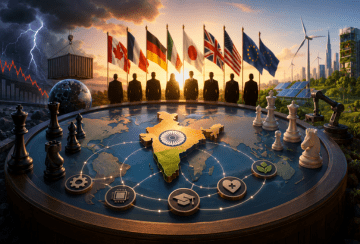
G7 Summit 2026: Key Business Risks and Opportunities for India
- Posted by GRMI
- Categories Blog, pgdrm blog
- Date June 5, 2026
G7 Summit 2026: Key Business Risks and Opportunities for India
Jump to ↓
The G7 Summit 2026 highlighted major global developments that will shape business strategy, risk management, and international trade in the years ahead. From AI governance and critical minerals to geopolitical tensions and supply chain resilience, the summit offers valuable insights for organisations preparing for an increasingly uncertain business environment. This blog explores the key takeaways and what they mean for businesses and risk professionals in India.
After Evian: How the G7 Summit is Rewriting the Corporate Playbook
Recently, the 52nd G7 Summit was held from 15th-17th June 2026 in Evian les Bains, France and was attended by some of the leaders of the world’s most advanced economies to discuss a variety of issues like macroeconomic imbalances, energy security, artificial intelligence governance, geopolitical conflicts and supply chain resilience. For risk managers and business leaders, G7 summit statements are more than diplomatic discussions. They are vital for providing early signals about future risks and opportunities. Decisions taken at Evian are likely to influence regulations, trade patterns, technology rules and investment flows for years to come. For India, which was invited as one of the many special partner nations, the summit has important implications for both business growth and risk exposure.
This blog examines three major risk themes from the Evian summit and explores what they could mean for companies operating in India and across global markets.
Global Economic Imbalances and Trade Risk
A major focus of France’s G7 presidency was reducing global economic imbalances. G7 leaders argued that countries need to coordinate their economic policies to avoid trade conflicts, financial instability and damage to domestic industries. They also asked international organisations like the IMF and OECD to monitor how the policies of major economies affect global trade and financial balances. Although China was not directly named, the statement clearly criticised China’s reliance on exports, industrial subsidies and low domestic consumption. This suggests that G7 pressure on China will continue long term rather than being a temporary issue.
What this Means for Risk Managers
- Political and country risk: Businesses can no longer rely only on indicators such as GDP growth and inflation. Risk assessments should also consider G7 policy decisions and geopolitical developments.
- Trade risk: Companies that depend heavily on China for supplies or revenue may face growing risks as G7 countries introduce coordinated trade measures.
- Opportunity for India: India and the EU aim to finalise a Free Trade Agreement (FTA) by the end of 2026, which could create new opportunities for Indian industries such as pharmaceuticals, textiles and engineering.
Critical Minerals: A New Supply Chain Challenge
The G7 also released a separate statement on critical minerals such as lithium, cobalt, nickel and rare earth elements. These minerals are essential for electric vehicles, semiconductors, batteries and renewable energy technologies. The group committed to reducing dependence on any single country for these resources and building more diverse supply chains. In simple terms, governments now see critical mineral supply chains as a strategic security issue, not just a business concern. Companies that do not understand where these materials are coming from may be exposed to significant risks.
What This Means for Risk Managers
- Supply Chain Risk: Companies in sectors such as electric vehicles, defence and clean energy should identify where their critical minerals come from and assess any dependence on a single supplier or country.
- Scenario Planning: China’s temporary restrictions on rare earth exports during the 2025 US-China trade tensions showed how quickly supply disruptions can occur. Companies need contingency plans that can be activated immediately.
- India’s role: India has important reserves of critical minerals and is emerging as an alternative supplier. However, companies sourcing from India will also need to meet stricter environmental and ethical sourcing standards required by G7 markets, particularly in Europe and North America.
AI Governance: From Innovation to Compliance
Artificial Intelligence (AI) was one of the key topics at the Evian summit. G7 countries agreed to work with technology companies to promote the safe and responsible use of AI through measures like transparency requirements, child safety protections and governance frameworks. This shows that AI regulation is moving from discussion to implementation.
For businesses, this means that AI related compliance requirements are likely to increase. Companies operating across multiple countries may have to comply with different AI regulations, including those being developed in Europe, the United States, the UK and Japan.
What This Means for Risk Managers
- Technology and compliance risk: Companies using AI, especially in customer facing services or critical infrastructure should include AI regulatory risk in their risk assessments
- India’s position: India participated in the AI discussions and is developing its own AI regulations. As these rules are likely to align with G7 standards, Indian IT firms such as TCS, Infosys, Wipro and HCL can benefit from greater regulatory requirements with international clients. However, they must also prepare for new compliance requirements.
- Opportunity for GCCs: India’s growing network of Global Capability Centres (GCCs) plays a major role in AI development and data management. Companies operating GCCs should establish AI risk and compliance frameworks that meet global standards.
Geopolitical Risk: Ukraine, Iran and Energy Markets
The G7 reaffirmed its support for Ukraine and announced further military and energy assistance along with tighter sanctions on Russia. At the same time, discussions between the United States and Iran suggested a possible easing of tensions in the Middle East and a potential reopening of key energy trade routes.
These developments highlight how geopolitical events can quickly affect global energy and commodity markets.
What This Means for Risk Managers
- Energy and Commodity Risk: Continued conflict in Ukraine could keep energy prices and transportation costs volatile, affecting industries that rely heavily on fuel and raw materials..
- Sanctions risk: Companies that do business with Russian firms or have exposure to Russian markets face increasing compliance and legal risks as sanctions become stricter.
- India’s challenge: Since 2022, India has benefited from importing discounted Russian oil. If G7 countries strengthen sanctions further, Indian refiners may face higher costs and may need to find alternative suppliers. Energy companies should already be preparing for this possibility.
Building a G7 Responsive Risk Framework
The Evian summit does not require companies to redesign their entire risk management system but it does highlight areas that deserve greater attention.
A good starting point includes
- Geopolitical monitoring: Track major G7 policy decisions and include them in regular risk assessments
- Supply chain reviews: Identify dependence on critical minerals, Chinese suppliers or Russian linked partners and develop alternative sourcing strategies. AI compliance planning: Assign responsibility for AI governance and prepare for future regulations before they become mandatory.
- India-focused strategy: Indian companies with international operations should closely monitor developments such as the India-EU Free Trade Agreement, critical mineral partnerships, and emerging AI regulations as these create both opportunities and risks.
Conclusion
The Evian Summit was more than a diplomatic gathering. It was a demonstration of geopolitical risk management in action. Decisions on macroeconomic coordination, critical mineral supply chains, AI governance and strategic alignment will influence corporate strategy, risk assessments and investment decisions for years to come.
For Indian businesses, these developments carry particular significance. As India assumes a larger role in global supply chains, technology governance, and international economic cooperation, the G7 agenda is no longer a distant policy discussion. It has direct implications for business operations, market opportunities and long term strategic planning.
In an increasingly interconnected world, organisations that can interpret geopolitical developments as business risks and respond with robust risk management frameworks will be best positioned to succeed. The challenge is no longer whether geopolitical risk matters, it is whether companies are prepared to anticipate, assess and manage it effectively.
You may also like

Best Post Diploma Courses in India for 2026

Best IT Diploma Courses with Highest Job Demand in 2026