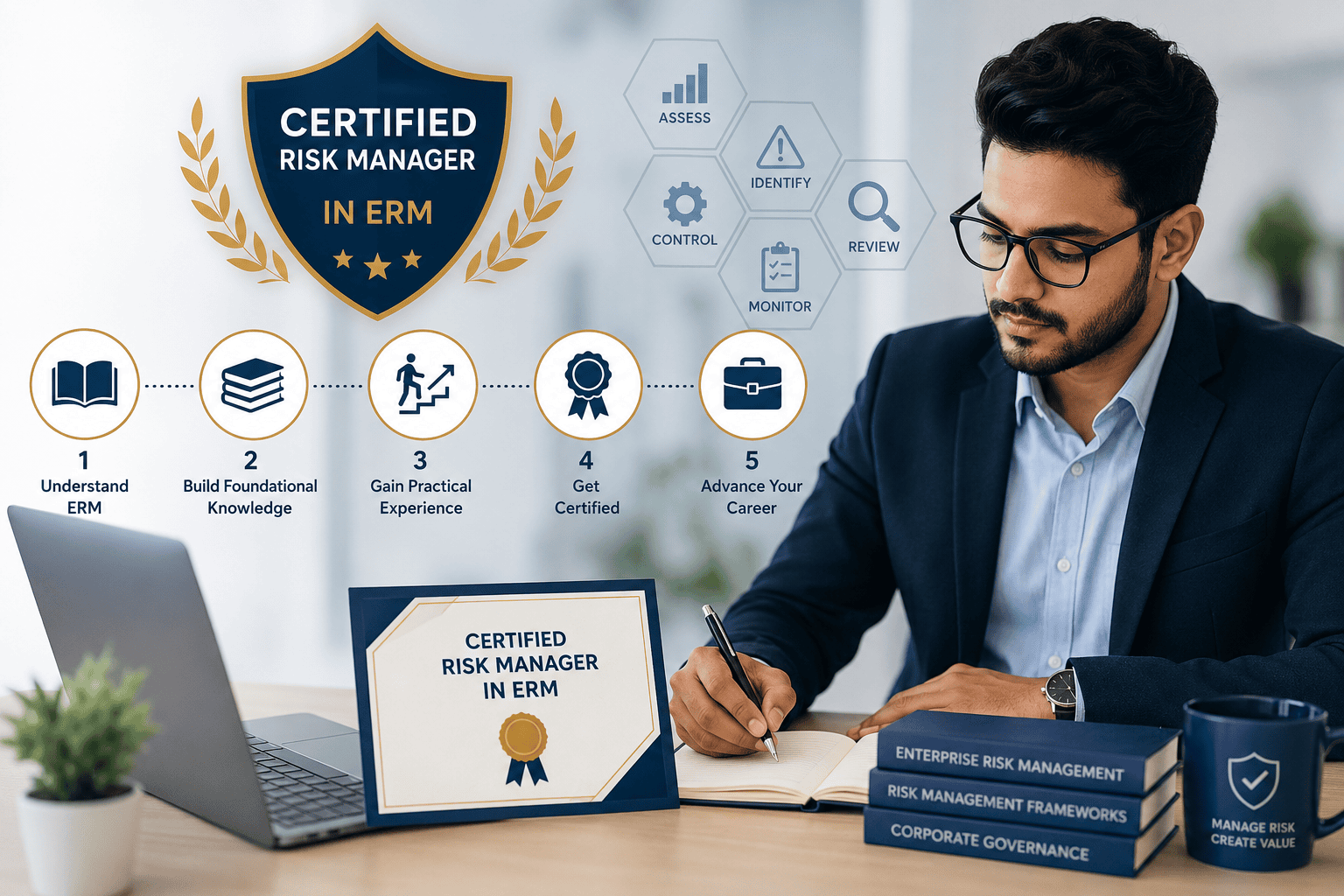
How to Become a Certified Risk Manager in ERM Career Guide

- Posted by GRMI
- Categories Blog, pgdrm blog
- Date August 19, 2026
How to Become a Certified Risk Manager in ERM Career Guide
Jump to ↓
Author: Anjori Gupta
Explore how to become a certified risk manager, including the education, certifications, skills and practical experience needed to build a career in enterprise risk management.
How to Become a Certified Risk Manager in Enterprise Risk Management
What does it take to build a career where you can help organisations identify threats, strengthen resilience and make better strategic decisions?
As businesses face increasing uncertainty from cyber threats, regulatory changes, economic volatility, supply chain disruptions and technology risks, enterprise risk management (ERM) has become an important part of business strategy. Organisations need professionals who can look beyond individual risks and understand how different threats can affect the business as a whole.
This has created growing opportunities for professionals who want to build a career in risk management. But becoming a risk manager involves more than earning a certification. A strong career typically combines relevant education, specialised risk knowledge, practical experience and professional development.
If you are wondering how to become a certified risk manager, this guide explains the qualifications, certifications, skills, experience and career pathways that can help you move towards a career in enterprise risk management.
What Does an Enterprise Risk Manager Do?
An enterprise risk manager looks at risks across an organisation rather than focusing on only one function or category. Their role is to help businesses understand potential threats, assess their impact and develop strategies to manage them.
Depending on the organisation and role, responsibilities may include:
- Identifying and assessing business risks
- Developing risk mitigation strategies
- Monitoring risk indicators and controls
- Supporting risk governance and reporting
- Conducting scenario and impact analysis
- Working with different business functions
- Advising management on risk-related decisions
- Helping integrate risk management with business strategy
The role requires both analytical ability and an understanding of how different parts of a business operate.
How to Become a Certified Risk Manager?
There is no single route to becoming a certified risk manager. However, the following steps can help you build the knowledge and experience required for a career in enterprise risk management.
1. Build a Relevant Educational Foundation
A bachelor’s degree is generally a useful starting point for a career in risk management. Students from Finance, Economics, Commerce, Business Management, Statistics, Mathematics, Engineering and related disciplines can develop relevant foundations.
However, risk management is not limited to finance graduates. Enterprise risk covers areas such as operations, technology, compliance, strategy and governance, which means professionals from different academic backgrounds can enter the field.
For graduates seeking specialised knowledge, a postgraduate risk management programme can provide a more focused understanding of the field.
2. Develop Knowledge of Enterprise Risk Management
Before pursuing a certification, it is important to understand the fundamentals of enterprise risk management.
This includes learning how organisations:
- Identify and assess risks
- Establish risk appetite
- Develop risk controls
- Monitor emerging risks
- Manage operational and strategic risks
- Respond to disruptions
- Build risk governance frameworks
- Connect risk management with business objectives
Understanding these areas helps professionals look at risk from an organisation-wide perspective rather than treating individual risks in isolation.
3. Choose a Relevant Risk Management Certification
Professional certification can help demonstrate specialised knowledge and commitment to the profession. However, the right certification depends on your career goals and the area of risk management you want to pursue.
Some recognised certifications include:
Certification | Primary Focus |
Financial Risk Manager (FRM) | Financial and market risk |
Professional Risk Manager (PRM) | Professional risk management |
RIMS-Certified Risk Management Professional (RIMS-CRMP) | Enterprise risk management |
Certified in Risk and Information Systems Control (CRISC) | IT risk and information systems controls |
Certification in Risk Management Assurance (CRMA) | Risk management assurance and internal audit |
For someone specifically interested in enterprise risk management, a certification focused on broader organisational risk can be particularly relevant.
However, certification should be viewed as one part of career development rather than a substitute for education and practical experience.
What Skills Are Required for an Enterprise Risk Manager?
Technical knowledge is important, but effective risk managers also need strong analytical and interpersonal skills.
Analytical Thinking
Risk professionals need to interpret information, identify patterns and assess the possible impact of different risks.
Problem-Solving
Risk management often involves dealing with situations where there is no single obvious solution. Professionals need to evaluate alternatives and recommend appropriate responses.
Communication
Risk managers frequently communicate with senior management, business teams, auditors and other stakeholders. They need to explain complex risks in a clear and practical manner.
Decision-Making
Risk professionals must understand how different risk scenarios could affect business objectives and support informed decision-making.
Data Analysis
Organisations increasingly rely on data to monitor risks, identify trends and assess potential outcomes. Data analysis skills can therefore be valuable across many risk roles.
Business Understanding
An enterprise risk manager needs to understand how finance, operations, technology, people and strategy interact. This broader business perspective is central to effective ERM.
Does Practical Experience Matter?
Yes. A certification can demonstrate knowledge, but practical experience helps professionals understand how risk management works in real business situations.
Aspiring risk professionals can gain relevant experience through internships, projects or entry-level roles such as:
- Risk Analyst
- Risk Associate
- Compliance Analyst
- Internal Audit Associate
- Financial Analyst
- Operational Risk Analyst
- Risk Consultant
Professionals can also move into risk management from related functions such as audit, compliance, finance, consulting, operations or technology risk.
Practical exposure allows professionals to apply risk frameworks, analyse real business problems and understand how organisations respond to uncertainty.
Certification vs Degree: Which One Do You Need?
A degree and a professional certification serve different purposes.
A degree provides a broader academic foundation and can help graduates enter the profession. A certification focuses on specialised knowledge and can demonstrate professional competence in a particular area of risk management.
For many candidates, they can complement each other rather than being alternatives.
A graduate may begin with a relevant degree or postgraduate programme, gain practical experience and then pursue a certification aligned with their career goals.
How Can an ERM Course Help Your Career?
A specialised enterprise risk management course can provide structured learning for students and professionals who want to understand risk beyond a single domain.
A well-designed programme can introduce learners to financial risk, enterprise risk, governance, compliance, data analysis and other areas that influence organisational decision-making.
For graduates who want a focused entry into the profession, a postgraduate programme can also provide a structured environment to develop both conceptual knowledge and practical understanding.
Building a Career in Risk Management with GRMI
For graduates looking to build a specialised career in risk management, GRMI’s 1-year Post Graduate Diploma in Risk Management (PGDRM) offers a focused pathway into the field.
The programme has a 97% placement track record, with students progressing towards opportunities across different industries. GRMI’s recruiter ecosystem includes leading organisations such as EY, KPMG, Deloitte, PwC, Accenture, Tata Motors, Maruti Suzuki, Titan and American Express.
The PGDRM can be considered by graduates who want to develop a strong foundation in risk management before progressing towards specialised roles and professional certifications. It provides a structured route for candidates looking to understand how risk influences business decisions and build a career in this growing field.
What Career Opportunities Are Available in Enterprise Risk Management?
Enterprise risk management offers opportunities at different stages of a professional’s career.
Career Stage | Possible Roles |
Entry Level | Risk Analyst, Risk Associate, Compliance Analyst |
Mid-Level | Risk Manager, Risk Consultant, Operational Risk Manager |
Senior Level | Senior Risk Manager, Risk Director, Head of Enterprise Risk |
Leadership | Chief Risk Officer, Group Head of Risk |
Professionals can also specialise in areas such as financial risk, operational risk, technology risk, cyber risk, compliance, ESG and strategic risk.
How Much Can an Enterprise Risk Manager Earn?
Risk management salaries vary depending on experience, industry, specialisation, location and organisation. Entry-level professionals generally earn less than experienced risk managers, while senior professionals and leadership roles can command significantly higher compensation.
Professional certifications, specialised knowledge, practical experience and the ability to take on greater responsibility can contribute to career progression and earning potential.
Rather than focusing only on the starting salary, aspiring professionals should consider the long-term career progression available across risk management roles.
How Long Does It Take to Become a Risk Manager?
There is no fixed timeframe because career paths differ based on educational background, experience and specialisation.
A typical pathway may involve completing a relevant degree or postgraduate programme, entering an entry-level risk role, developing practical experience and pursuing a relevant certification. With experience, professionals can progress from analyst-level positions to risk management and senior leadership roles.
Becoming certified and becoming a risk manager are also different milestones. A certification may demonstrate professional knowledge, while managerial positions generally require practical experience and the ability to handle greater organisational responsibility.
Is Enterprise Risk Management Certification Worth It?
An ERM certification can be valuable for professionals who want to specialise in enterprise risk management or demonstrate their knowledge to employers.
Its value is strongest when combined with relevant education and practical experience. Certification can help professionals deepen their understanding of risk frameworks, strengthen their professional profile and support progression into specialised roles.
However, candidates should choose a certification based on their career goals rather than pursuing a credential simply because it is popular.
Conclusion
Building a career as a certified risk manager involves more than completing one course or examination. It requires a combination of education, enterprise risk management knowledge, professional certification, practical experience and essential business skills.
For graduates, a specialised risk management programme can provide a structured starting point, while professional certifications and practical experience can support continued career development.
As organisations continue to integrate risk into strategic decision-making, professionals who can understand risks from an enterprise-wide perspective can find opportunities across consulting, financial services, technology, manufacturing and other industries.
If you are considering a career in enterprise risk management, building the right combination of knowledge, certification and experience can help you take the next step with greater confidence.
FAQ's
Start with a relevant educational background, develop knowledge of enterprise risk management, gain practical experience and pursue a professional certification aligned with your career goals.
The best certification depends on your career focus. Certifications such as RIMS-CRMP are specifically aligned with enterprise risk management, while FRM, PRM and other credentials focus on different areas of risk.
A relevant bachelor’s or postgraduate qualification can provide a strong foundation. Professional certifications, practical experience and skills in analysis, communication and decision-making can further support career progression.
Yes. Enterprise risk management covers financial, operational, strategic, technology and compliance risks. Graduates from areas such as Economics, Commerce, Business Management, Statistics, Mathematics, Engineering and technology can also pursue risk management careers.
An enterprise risk manager needs analytical thinking, problem-solving, communication, decision-making, data analysis, stakeholder management and a strong understanding of business operations and risk.
There is no fixed timeframe. Candidates typically begin with relevant education, enter an entry-level risk role, gain practical experience and pursue relevant certifications before progressing into managerial positions.
Yes, an ERM certification can strengthen specialised knowledge and professional credibility. However, it is most valuable when combined with relevant education and practical experience.
Depending on the certification, it may cover areas such as risk identification, assessment, governance, risk response, monitoring, controls, risk frameworks and enterprise-wide risk management practices.
Career opportunities include Risk Analyst, Risk Associate, Risk Consultant, Risk Manager, Enterprise Risk Manager, Risk Director, Head of Risk and Chief Risk Officer.
Compensation varies according to experience, industry, location, organisation, specialisation and seniority. As professionals progress into managerial and leadership positions, their earning potential generally increases.
Student Voices, Real Impact

Saoumita Chatterjee
It gave me opportunities that no MBA college could. With exceptional ROI and exposure to the Big 4, it's a game-changer for freshers.

Saurav Nath
My search for an education institute stopped at GRMI as it helped me become a risk intelligent professional and successfully secure placement.

Yash Nagaich
From day one, the faculty support at GRMI helped me strengthen my fundamentals and prepare for a successful career.

Sarthak Kapoor
The industry-focused curriculum and faculty guidance helped me apply risk and audit concepts effectively during interviews and beyond.

Aditya Ghosh
The industry-focused curriculum and placement support helped me build confidence and successfully secure my placement.

Anzar Mehboob Berg
The mix of hands-on learning, industry exposure, and faculty mentorship helped me transition smoothly into my career through placements.

Jayita Gulati
Learning directly from industry experts gave me a practical perspective that proved invaluable during the placement process.

Shashank Modi
The opportunity to learn from both academic experts and industry leaders played a key role in helping me begin my career with a leading organization.

Tanya Wadhwa
With continuous mentor guidance and excellent placement support, I was well-prepared to handle interviews confidently.

Saoumita Chatterjee
It gave me opportunities that no MBA college could. With exceptional ROI and exposure to the Big 4, it's a game-changer for freshers.

Saurav Nath
My search for an education institute stopped at GRMI as it helped me become a risk intelligent professional and successfully secure placement.

Yash Nagaich
From day one, the faculty support at GRMI helped me strengthen my fundamentals and prepare for a successful career.

Sarthak Kapoor
The industry-focused curriculum and faculty guidance helped me apply risk and audit concepts effectively during interviews and beyond.

Aditya Ghosh
The industry-focused curriculum and placement support helped me build confidence and successfully secure my placement.

Anzar Mehboob Berg
The mix of hands-on learning, industry exposure, and faculty mentorship helped me transition smoothly into my career through placements.

Jayita Gulati
Learning directly from industry experts gave me a practical perspective that proved invaluable during the placement process.

Shashank Modi
The opportunity to learn from both academic experts and industry leaders played a key role in helping me begin my career with a leading organization.

Tanya Wadhwa
With continuous mentor guidance and excellent placement support, I was well-prepared to handle interviews confidently.
You may also like

Risk Management Explained: Methods, Process, Types & Benefits
Risk Analyst Jobs for Freshers: Career Guide in India

