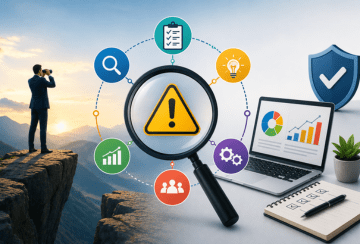
Risk Identification: Methods, Importance & Best Practices
- Posted by GRMI
- Categories Blog, pgdrm blog
- Date June 23, 2026
Risk Identification: Methods, Importance & Best Practices
Jump to ↓
Author: Jayant palan
Risk identification is the structured process of recognising potential threats that could impact a business’s objectives. It helps organisations detect risks early, reduce uncertainty, and prepare effective mitigation strategies. By identifying financial, operational, strategic, compliance, and cybersecurity risks, businesses can make better decisions and strengthen resilience. Continuous risk identification ensures organisations stay prepared for evolving challenges and maintain long-term stability.
Risk Identification: A Must For Every Business
Risk identification is the process of systematically recognising and documenting potential events or conditions that could pose a threat to a business’s objectives. This blog explains what risk identification is and why it is important to identify potential risks.
Why Risk Identification Is Important
Risk identification is vital because companies cannot mitigate threats they do not recognise. Businesses often experience losses due to variables outside their control, which may include market fluctuations, geopolitical upheaval, and even unexpected events like natural disasters. While organisations may not be able to eliminate these uncertainties, risk identification helps them proactively recognise risks, enabling better management and response strategies. Without risk identification, businesses become vulnerable to threats that negatively impact key areas such as profit, reputation, and employee loyalty. That is why risk identification is necessary to ensure that risks are properly identified and a plan is developed to counter them before they occur.
As organisations place greater emphasis on enterprise risk management, structured learning pathways such as the PGDRM offered by the Global Risk Management Institute (GRMI) help professionals develop practical expertise in identifying, assessing, and managing real-world business risks.
Benefits of Risk Identification
When implemented effectively, risk identification delivers several advantages:
- Improved Decision Making: Understanding potential outcomes and risks allows decision-makers to make well-informed business decisions. Proactive risk identification ensures that leaders have strategies in place before crises occur.
- Enhanced Resilience: Risk identification increases an organisation’s ability to withstand unforeseen challenges and adapt to change. It helps in preparing contingency plans and improving resource allocation.
- Resource Allocation: It helps organisations prioritise where to direct human and financial resources, ensuring that high-impact threats receive appropriate attention.
- Identify Opportunities: Risk identification is not only defensive but also helps organisations uncover opportunities for improvement and gain a competitive advantage.
- Improves Risk Communication and Culture: When risk identification is embedded in organisational processes, it encourages transparency and improves collaboration across teams.
- Early Mitigation: By identifying risks early, businesses gain time to develop strategies that reduce the likelihood of negative outcomes.
Types of Risks to Consider
There are multiple risks a business must consider when fulfilling its objectives. Some of the most common types include:
- Strategic Risks: Risks arising from business decisions and strategic direction changes, often impacting profit and customers.
- Financial Risks: Risks that lead to financial disruption and can significantly affect profitability and operations.
- Operational Risks: Risks arising from disruptions in internal or external business operations.
- Compliance Risks: Risks of non-compliance with laws and regulations, leading to legal and financial penalties.
- Cybersecurity and Technology Risks: Risks from cyberattacks, data breaches, and system failures.
- Environmental Risks: Risks caused by climate change and natural disasters that affect supply chains and production.
Common Risk Identification Methods
Organisations combine several proven techniques when identifying risks. These include:
- Brainstorming Sessions: Helps anticipate “what if” scenarios such as cyberattacks or natural disasters.
- SWOT Analysis: Evaluates strengths, weaknesses, opportunities, and threats to understand risk exposure.
- Root Cause Analysis: Identifies the underlying causes of issues to prevent recurrence.
- Incident Reporting Systems: Helps identify risks early by encouraging reporting of incidents and near-misses.
- Stakeholder Interviews: One-to-one discussions with experts to gain deeper insights into potential risks.
- Probability Analysis: Uses data and statistical models to assess likelihood and impact of risks.
Tips for Effective Risk Identification
- Choosing the right strategy: Organisations should select an approach aligned with their business needs and risk profile.
- Seek diverse perspectives: Using multiple techniques ensures a more complete understanding of risks.
- Treat risk identification as ongoing: Risks evolve continuously, so regular updates are essential.
- Document everything: Maintaining a risk register improves clarity and decision-making.
- Invest in tools and technology: Modern tools help streamline risk tracking, scoring, and reporting.
Questions to Help Identify Business Risks
Sometimes the best way to identify risks is by asking the right questions:
- What external events could disrupt operations within the next 12 months?
- How vulnerable are we to cyber threats?
- What is the likelihood of previously experienced risks recurring?
- What would happen if a key supplier or employee became unavailable?
- What could prevent the organisation from achieving its objectives?
- What could damage business reputation or stakeholder trust?
What’s the Next Step After Risk Identification?
Risk identification is only the first step in a broader risk management cycle. Once risks are identified, organisations move to risk assessment, where the likelihood and impact of each risk are evaluated. This helps prioritise risks and allocate resources effectively.
After assessment, organisations develop mitigation strategies such as risk avoidance, risk transfer (insurance), or risk acceptance for lower-priority risks. Monitoring tools like risk registers help track changes over time. Risk management is continuous, and regular updates are necessary as new risks emerge.
Final Thoughts
Risk identification helps organisations navigate uncertainty and make informed decisions. Businesses must identify risks, document them clearly, and apply multiple methods to analyse them effectively. Organisations that prioritise risk identification are better equipped to handle uncertainty, protect assets, and seize opportunities.
While risk identification does not eliminate risk, it provides a structured and proactive approach to managing uncertainty, improving resilience and long-term stability.
FAQ's
Risk identification is the process of recognising and documenting potential threats that could affect a business’s objectives.
It helps organisations identify potential risks early, improve decision-making, and develop effective mitigation strategies.
Common methods include SWOT analysis, brainstorming, root cause analysis, stakeholder interviews, and probability analysis.
Strategic, financial, operational, compliance, cybersecurity, and environmental risks are most commonly identified.
No, it is an ongoing process that must be regularly updated as business conditions and environments change.
You may also like

Best Post Diploma Courses in India for 2026

Best IT Diploma Courses with Highest Job Demand in 2026